
PODCAST TRANSCRIPT | EPISODE 157: FROM GOLD TO BRASS, Part 2
Epi157pic

FROM OUR HOME TO YOURS w/ Nancy Campbell

EPISODE 157 –  FROM GOLD TO BRASS, Part 2

King Rehoboam exchanged gold for brass. What are we experiencing in our lives as wives and mothers? Are we living the gold, or have we exchanged it for brass?

Announcer: Welcome to the podcast, From Our Home to Yours, with Nancy Campbell, founder and publisher of Above Rubies.

Nancy Campbell: Hello, ladies. I'm back with you again, and I'm going back to the Scriptures we were talking about last week, 1 Kings 14:26-28, and I'm going to read it again. He, the King of Egypt, took away from Rehoboam, who was the son of Solomon: “He took away the treasures of the house of the Lord, and the treasures of the king's house; he even took away all: and he took away all the shields of gold which Solomon had made. And King Rehoboam made in their stead brazen shields, and committed them unto the hands of the chief of the guard, which kept the door of the king's house. And it was so, when the King went into the house of the Lord, that the guard bare them, and brought them back into the guard chamber.”

And so we were sharing last time how that the King of Egypt came and stole from King Rehoboam, from the temple, and from his own house, the king's house, all the treasures. And he took them away. Rehoboam inherited amazing riches. Even the temple, they say, looking at it in today's value, that that temple in Jerusalem would have been worth $56 billion.

It was filled with treasures of gold and precious jewels, and also the king's house, it was filled with all treasures. They were taken away in just three generations from David to King Solomon and to Rehoboam. The riches were stolen.

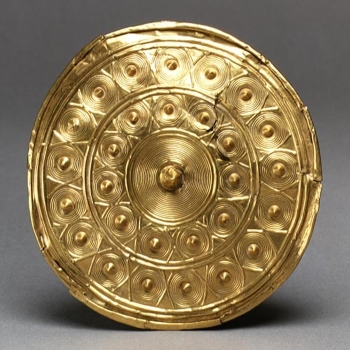
But here it talks about the shields of gold which King Solomon had made. He made 500 shields, 200 large shields, all made out of hammered gold the Scripture says. And then he made 300 smaller shields, also out of hammered gold. These were also taken.

FROM GOLD TO BRASS IN FIVE YEARS

But what did Rehoboam do? He, instead, because the gold shields were gone, which were worth, one commentator says, $53 million, another says $37 million. Quite a bit of discrepancy there, but whatever, it was still millions and millions. So Rehoboam made shields of brass to take their place.

Now these were not the real thing. They were not the gold. They were counterfeit. But they looked pretty good, because you can shine up brass pretty well. Have you ever tried to do that? You can get Brasso, and you shine up the brass and it can really shine pretty well.

But it is a counterfeit. It's only brass. It's not the real gold. And sadly, Rehoboam seemed to be satisfied with the counterfeit. The Bible tells us that when he went to the temple of the Lord, he would get his guard, I'm sure guards  (plural) too, but there would be one who was particularly in charge.

And they would carry the brass shields to the temple. It was like a parade. And then when he would come back to the king's house, they would carry them back again and put them away in the king's house again. So that every now and then they would parade the shields for everyone to see.

I'm sure the guard in charge of these shields was informed that he had to keep them shined up, so they were continually clean and shined. So they were shiny, and when they went out, people would say, “Oh, look at those beautiful brass shields!”

But there would be those who remembered the gold ones. But there would be children who were growing up who didn't remember the gold ones. They would think that the brass ones were very special. You see, this is the thing with counterfeit, dear ladies. And it's something we have to really watch, because we go from the real, the real gold, to brass. And the brass is the counterfeit.

FROM THE REAL TO REPLACEMENT

And what does counterfeit mean? I actually wrote down the dictionary meaning somewhere here. And let me see, yes, it means, “fraudulent, imitation of something else.” So it can look real, but it's not real. And we go from that to replacements. And we put something else in its place of the real.

I mean, we go back to normal. And what is the replacement? People begin to think that it's normal. And they don't know that they really haven't got the real. And this is where, in many areas of life, we have to really check it out. Are we living in the real in this area? Or are we living in the counterfeit? A substitute. A replacement. But now you're quite normal.

I'm thinking back in the days of Israel, and then Nehemiah, who came to build up the temple of the Lord that had been wiped out and ransacked by the king of Babylon. And the Jews had been in Babylon for 70 years.

God raised up King Cyrus, who was a heathen king, but an incredible king, and actually a very wonderful man. A man who was prophesied by name 150 years before he was even born. You can read about him in the last Scripture in Isaiah, chapter 44. And then in the first few verses of Isaiah 45. It talks about Cyrus, “My anointed, the one I have raised up.”

And yet he was a heathen king. But it's amazing. I have read the history of Cyrus and it's so incredible. I read Cyropedia by Xenophon. And when I was reading that book, I was getting quite convicted, like as though I was reading the Bible. And it was just about this heathen king.

But he was a special personality. When he was a child, he had this very, very generous spirit. He loved to give gifts. He was always thinking about other people. And it's amazing how God knew that He would have to raise up a personality, a man with this kind of big generous heart to fulfill His purposes. Because the people of Israel were captive in Babylon. They were slaves in Babylon. They'd been there for 70 years.

When King Cyrus came on the scene, he was used of God to release them and send them back. Now not every king would do that. In fact, as Cyrus grew in his life, and then he became a general, and then he became a king, he was an amazing king with his soldiers.

Whenever one of his soldiers would do anything that was good, he would call a meeting, and he would tell everybody about what they'd done. And he would give them a gift. And he would do this to every little thing they would do that was good. His soldiers loved him.

And even when he came to take over countries, the people wanted him to take over, because he was so good to  them. They wanted to be taken over by him. So he became the king of the four corners of the earth.

Then God raised him up. He had planned for him before he was even born. He'd even confessed his name prophetically 150 years before he was born. And God used him to release the people to go back. He said, “You can go back, and here's money to build your temple. And you can take back your treasures that were taken away from you.”

I mean, what king would do this? But that was the one that God had raised up to do it. And so they had come back to Jerusalem, and they were beginning to build up the temple again. And the foundation was laid.

Oh, so many of those had been born in Babylon. They'd never seen the old temple. And they were so thrilled, and they were shouting, rejoicing, with great shouts of joy, and they were overcome with joy. The foundation of the temple was built again!

But then there were some of the old ones who had come back. They had remembered when they were young. They remembered that beautiful temple of gold and beautiful jewels. When they saw the foundation was nothing like the foundation of that old beautiful temple. they wept. So we had some of the people weeping. And some of the people rejoicing. The rejoicing ones, they didn't know or remember the real. So they were content with that which wasn't so good, the replacement.

So here we are, back to Rehoboam. Now he is living in the days of replacement. Yes. And who came along and stole it? It was Shishak, the king of Egypt. Now Egypt in the Bible is always a type of the flesh, of the flesh and the devil and all those things that come against us. We read about it. Everything in the old has its counterpart in the new.

We go to 1 John 2:15-17: “Love not the world, neither the things that are in the world. If any man love the world, the love of the Father is not in him. For all that is in the world, the lust of the flesh, and the lust of the eyes, and the pride of life, is not of the Father, but is of the world. And the world passeth away, and the lust thereof; but he that doeth the will of God abideth forever.”

And so it's talking about here, the lust of this world. And Egypt always speaks of the flesh, and the lust of this world. It's those things that come and steal from us the real. And they stole from Rehoboam. So now he's doing the replacement business. And he's got his brass shields and he's bringing them out and parading them, but they're not for real.

And he put something instead of them. In 2 Chronicles 12:10 it's repeating the same story. And it says: “Instead of which king Rehoboam made shields of brass.”

And so, lovely ladies, I thought we'd look at a few things today where we need to check our lives and see whether we are living in the real or we are living in the counterfeit. Whether we have the gold, or whether we have the brass.

I want the gold. Don't you?

The gold is God's pure truth. And it is gold. The Word of God says, I think it's in Psalms 12:6. Let's go to it: “The words of the Lord are pure words: as silver tried in a furnace of earth, purified seven times.”

Now both gold and silver are tried. They are tried in a furnace. They're put in a furnace so that all the rubble and that which is not pure comes to the surface. They take it all off the top until they get the pure gold. And they do it with silver too.

In this Scripture, the Word of God says that the Word itself is purified in the furnace seven times. And it's also purified like gold, because the Word is called “gold.” There's some beautiful Scriptures about that in Psalm 19:7-11. Beautiful Scriptures about the Word of God.

And then in Psalm 19:10, it says: “The law of the Lord is more to be desired than gold, yea, than much fine gold.” David said those words, and yet David, he was the one who was filled with riches of gold. I mean, David saved up and amassed for the temple. I was telling you about that last session.

The Bible says that he got together 100,000 talents of gold, which would be worth about $45 billion  today, and 1,000,000 talents of silver, which would be worth about $10.8 million today. And he prepared all that for the temple.

So he had all that gold around him. And yet he said it was nothing compared to God's Words, His pure truth, that they were worth far more than much fine gold.

We go on to Psalm 119:72: “The law of Thy mouth is better unto me than thousands of gold and silver.”

And Psalm 119:127: “Therefore I love Thy commandments above gold; yea, above fine gold.” And so when we're looking for gold, ladies, we're looking for God's truth in His Word.

Many times we find that we actually have brass. We are living what our culture is doing, what society is doing. Sometimes it may be gold, but many times it's brass. It's the counterfeit.

WHAT ABOUT HAVING CHILDREN?

So let's start with just the basic thing of having children. Have we got the gold, or have we got the brass? I've done a few sessions on this before, so I'm not going to talk a lot about it. But we look at our culture today and we see in our society and America, the average number of children per family is 1.9.

That is more than in some European countries, where it comes down to 1.3, 1.2. Some are even less. They barely have replacements for their children. They are already dying nations. This is not what God intended. God intended His earth to be inhabited. God created us to have children. He didn't plan for us to stop having children.

God looks for the godly seed. In Malachi 2:15, it tells us how God looks for the godly seed. He wants godly children to come into this world. And there was a time when that was what happened. People had the children that God gave to them. Often that would be an average of six, seven, eight, nine, or maybe ten children.

Of course, there have always been, and still are, those who maybe can't have children. Maybe they only have one or two, because that's all God gives to them. And even the Bible never says, you must have so many children. No, no, no, that's not Bible.

But the Bible says, “Be open to the children that God loves to give us.” Yes, that He loves to give us, because every conception is from God. And when we stop conception, we are stopping a gift from God. And it's not God's plan for us to only have our 1.9 or maybe two children. “That's it!”

So what do we have? Do we have the gold? Or do we have the brass? Older ladies listening today, what are you teaching the young generation? What are you teaching them? Gold? What God says in His Word? Or brass, what our culture is doing today?

You see, the fact is that this brass, this replacement, it becomes normal. And people think, “Oh, that's normal.” And so, some people think, Oh, I mean, the normal thing today is, people have a couple of children, and they even have three.

And people will say, “Oh yeah, I guess you're done, are you?”

“Oh, yeah! We're DONE! That's it!”

I mean, that's normal talk. Normal? Really subnormal. It's really anti-normal, because it's not Bible-normal.

And so, lovely ladies, we have to be careful we're not caught up with a so-called normality that's not a normality, that's actually an unreality according to God's plan for our lives. And according to His Word.

WHAT ABOUT MOTHERS GOING TO WORK?

What about mothers going to work? It's normal today. It's the absolute norm. I mean, mothers who are staying home with their children, I guess, if you're one of those, and you're listening today, and you are home with your children, did you get these snide remarks? You get these people saying things to you, making out you're a little bit absurd. When really you are the normal one.

Isn't it sad that that which is the brass, not the gold, not the real thing, it's not the Word, and yet people think it's normal? Dear ladies, dear precious mothers, dear young girls listening today, let's never be those who accept what society's doing as the normal, unless it lines up with the Word. If it lines up with the Word, praise God. If it doesn't, it's brass! OK.

You either go for the brass or you go for the gold. I want to go for the gold, don't you? Yes, that's what I'm pursuing. The gold, the pure truth of the Word of God.

And what does it say in Titus 2? This is a word for young mothers and it's a word for older mothers, because the older mothers are to teach the younger mothers. It's not only Nancy Campbell teaching the young mothers. We need an army of older mothers teaching the young mothers.

Sadly, some of the older mothers are giving the wrong impression to young mothers. It's often the older mothers and the grandmothers who are saying these words to the young mothers. “Oh, you don't need any more children.”

Like my own dear mother. I remember every time I conceived, I was too scared to tell my parents. Then I got this little lecture each time after having a baby. “Now, Nancy, dear, you've got a lovely little family. You don't need any more children.”

Now my mother was a wonderful woman of God. Oh, she was a wonderful woman of prayer. She was a godly woman. But she didn't know. She was brainwashed. There have been generations from about my mother's generation who have been brainwashed in humanist understanding, not the Word of God.

In her very last years, she actually came to hear me speak and heard the revelation from the Word. She said, “Oh, Nancy, if only I had known.” And so, as older mothers, we have to know the truth. This is the thing that really saddens me. Each time I send out a new Above Rubies, I'm sure you have received your new issue, # 98. I trust it's a blessing to you and you're passing it on to others to share with them.

But I received, each time it happens, and I'll receive emails from older ladies. They write to me and say, “Nancy, oh, thank you so much for Above Rubies over the years. It was a great blessing as I was raising my children. But they're all grown now. So I don't need it anymore, so I am going to cancel.”

And I think, “Oh, what's happened? Here these lovely precious mothers, and they've raised their children, but now, they don't want it? They have no more need? Oh, no! We have a greater need than ever! My, I'm just not with my children grown, I'm in the next children with them grown. And they are now raising their children!

And yet I still need the message of Above Rubies, which is the message of what God says to women. I'm coming to the Lord every day, searching His Word. “Lord, please, reveal to me Your truth. I'm open for more,” because there is always more in the Word of God.

MOTHERHOOD IS NEVER DECREASING BUT ALWAYS ENLARGING

And when our children grow, we are not finished with motherhood. We are only entering into a larger area of motherhood. Our motherhood is growing. It is enlarging. We never think, “OK, that season's over!”

No, motherhood is always an enlarging season. It goes on from season to season, and the seasons are different, but it's always enlarging. And so now, I don't have six children around me, and then we added four later. We added another four adopted children, so that was ten children.

But no, now I have 50 grandchildren, so I have to enlarge my heart. I have to enlarge my sphere. I have to enlarge every part of my being because my family is enlarging. But that's not all. I now have 20-plus great-grandchildren and more on the way. So my life is continually enlarging.

And then there are mothers all around me. There are the mothers of the world, who need to hear God's truth, and His Words, and His encouragement. And so I have to enlarge. Every older mother, we have to enlarge.

We have to be constantly seeking God. “Lord, what do you want me to say to these young mothers? I dare not pass on brass. I've got to pass on gold.” And what does Titus 2:3 say? “The aged women likewise, that they be in behavior as becometh holiness, not false accusers, not given to much wine, teachers of good things.” Good things! Good things. We've got to teach good things.

And then it tells us what they are. And ladies, we have good things. "That they may teach the young women to be sober.” That doesn't literally mean to don't get drunk. It means to have a sober mind, to be able to pull your mind into gear, and not be overcome with self-pity and depression, and all these things.

NO TIME FOR WIMPINESS

No, mothers! We have no time for being wimpy. We have to be strong women of God who stand up for truth. We do not give way to deception. We do not give way to fear. We do not give way to all this silly nonsense of self-pity and junk. We've got to be women of strength with sober minds.

And to “teach the young women to love their husbands.” We've learned how to love our husbands, so we know how to teach the young women how to love their husbands.

“And to love their children. To be discreet, chaste, keepers at home.” There it is, three words.  “Keepers at home.” That's what the Bible says.

“Oh, that's not what culture says! That's not what society says! That's not what it says in the day I'm living in!”

GOD’S WORD IS FOR EVERY MOTHER IN EVERY GENERATION

But this is the Word of the Lord. This is up-to-date. The Word of God is not old fashioned. The Word of God is for every generation. The Word of God is alive and active and it's Word is for every mother in every generation because God knows what is best. That we are to teach young mothers to be keepers at home, to be those who are the guardians of their homes, watching over their homes. You cannot be a guardian if you're not there. You have to be there to watch over your home, to watch over your children.

“And to teach them to be good, obedient to their own husbands, that the Word of God be not blasphemed.”

Pretty powerful. In other words, we blaspheme the Word of God when we don't teach these truths. We blaspheme the Word of God when we don't embrace these truths.

Dear ladies, this is the pure gold of the Word of God. Which do you have? I'm sure, most of you who are listening, you've taken hold of the gold. You're home with your children, the blessed children God has given you, that you're training and preparing for Him, getting them ready to be part of His end-time army.

Oh, you have such a great career, the greatest career there is in the whole of this nation. There's no higher career. Oh goodness me. Women can go out and get their so-called high careers. But they're going to be left behind. They're not taking them into eternity with them.

But dear mothers, you're taking your career, you're taking your children, Every moment, every prayer, every time of pouring out of love, every time you sacrifice to raise godly children is eternal. And your children are eternal souls. And you're preparing them to not only impact this world but you're preparing future generations through your children.

But you are preparing them ultimately for eternity. Oh my. you have such a great career. And this is the purity, the pure gold of the Word of God. And can I tell you, anything less is brass? Counterfeit. Substitute. And how is it that now, this can be considered normal, when it's abnormal?

And so we have to defer. Oh, let's move on. Oh my. That's going to take a little bit of time. I might have to wait until next session. So just let me mention this. I have also mothers who write to me, and they say, “Nancy, you are becoming so political! Why don't you just keep to mothering?”

Well, dear ladies, I am keeping to mothering. because when I hare certain things to protect the family, it's not because I want to be political. It's because as an older mother, I am writing up to protect families, to protect the young families, to protect the future generations from being confused and taken up by that which is deception and evil.

And so I must stick to truth. All I am doing is sticking to truth. I have to be a truth-keeper. I have to be a truth-sharer. I have to be a truth-teller, because I love truth, and I do not want to be caught up in deception.

Someone wrote to me recently and said, “Oh, how dare you say we have an illegitimate president?” Oh yes, I must say that. Because the truth is that our current president is illegitimate. He did not win the election. President Trump won by far. That has been easily shown, clearly.

Of course, there are some who do not want to hear the facts, but we are living in the days of an illegitimate president. We are having to put up with nearly every day executive orders being signed that are bringing down the blessing of this nation.

We are seeing our border once again in disarray, with terrorists coming in, with sex traffickers coming in, with gang members coming in, and allowed to be brought into our states. Even here in Tennessee, in the middle of the country, our governor has allowed for these people to be brought and placed into our state.

This is beyond us. This is not what we are meant to have. We want a country that we don't want to bring evil in, for our children to live in that. And of course, yes, I have spoken against masks, and I have done podcasts on that because they are not from God.

God created us with open face to reveal His glory. He did not bring us into this world to cover our faces for a virus that has a 99.9% cure. They have cures, beautiful cures for this virus. They don't need vaccines, but of course they have come in, which is the ultimate underlying plan, which is de-population.

So therefore, I began to speak politically again, didn't I? Yes, but why? Because I want to save families. I want to save children. I mean, there is so much information coming out now of people who have been affected physically through taking the vaccine. People have died.

There are so many scientists and doctors, you can hear them on YouTube. These are not just weirdos. These are sane doctors and scientists who are revealing what is going to happen. They believe that much of the havoc will come, not just now, although it's already happening. But down the line, maybe this fall, maybe in months to come, maybe in years even, through the effects of these vaccinations.

So when I speak against them, I am trying to save lives, save precious children, save fertility, because they will affect fertility. I hope you hear my heart, dear ones, if you are listening. Maybe you have already taken the first shot. Wow. Well, it's a free world. You can do it. But from my heart to yours, I say, please, don't take the second. Don't go any further, because it won't be for your blessing.

OK, I've got to keep sharing next time. We'll get through this yet! All right!

“Father, I thank You so much, Lord God, for the darling precious ladies, children, young people listening today. And I pray that You will bless them, that you'll keep them in Your truth. You'll keep them going after gold, Lord God. And never turning to brass. I ask it in Jesus' Name. Amen.”

Nancy Campbell

www.aboverubies.org

Transcribed by Darlene Norris.

The following are some latest information on Covid.

VAERS COVID Vaccine Data (Vaccine Adverse Events Reporting System, USA).

329,021 reports through June 4, 2021:

  • DEATHS, 5,888
  • HOSPITALIZATIONS 19,597
  • URGENT CARE, 43,891
  • OFFICE VISITS, 58,800
  • ANAPHYLAXIS, 1, 450
  • BEL’S PALSY, 1,737
  • LIFE THREATENING, 5,885
  • HEART ATTACKS 2,190
  • MYOCARDITIS/PERICARDITIS, 1,087
  • THROMBOCYTOPENIA/LOW PLATELET, 1,564
  • MISCARRIAGES, 652
  • SEVERE ALLERGIC REACTION, 15,052
  • DISABLED, 4,583.

Latest news:

Simone Scott (19 years) underwent a heart transplant one month after developing what her doctors believe was myocarditis following her second dose of Moderna. She received the second vaccine May 1 and died June 11.
 

PODCAST TRANSCRIPT | EPISODE 156: GUARD YOUR TREASURES, Part One

Epi156pic

FROM OUR HOME TO YOURS w/ Nancy Campbell

EPISODE 156 –  GUARD YOUR TREASURES, Part One

King Rehoboam inherited the richest kingdom the world in his day. In only five years everything was taken away! We must hold fast that which we have!

Announcer: Welcome to the podcast, From Our Home to Yours, with Nancy Campbell, founder and publisher of Above Rubies.

Nancy Campbell: Hello, ladies. It's always so great to be with you. And maybe children listening too. I love to hear that children are listening. Sometimes when I go to Above Rubies retreats, I meet children who come with their mothers, to find that they love to listen my podcasts.

I hope also the older women are listening. We, as older women, we have to constantly be encouraged in the ways of God for women because we have to know God's way to pass it on to the next generation. So mothers, encourage your mothers to listen, the grandmothers. And grandmothers, encourage your children, your daughters, and grandchildren to listen. I pray that you are all blessed.

Well, I have been blessed the last couple of weeks. I celebrated my 80th birthday on the 27th of May. And I have had three parties to celebrate. Wow! That was really special. We had a great big family party here at our home.

That was so wonderful to have most of the family, not all, because some are in different states, and some weren't able to come. But a good part of this family was here and a few very close family friends. That was just a wonderful, wonderful night.

And then a dear friend, Erin Harrison, who lives here on the Hilltop, she said, “Nancy, I'd like to put on two parties for you. One for the older women, and one for the young mums.”

“Oh,” I said, “That would be so great. I'd love to have one for all the young mums and their little babies and toddlers, because I didn't want them to miss out.” So we were going to have a beautiful picnic out by our playground on our front lawn, near the volleyball court, so the little ones could play in the sand.

But it ended up a very, very wet, cold day, even in the summer! So we had it at Erin's place, and it was a beautiful luncheon. Just so lovely to enjoy the young mums around the Hilltop, and family young mums, and their little children.

And then last night we had a beautiful, beautiful evening. Erin called it “Fancy for Nancy.” Everyone came dressed up. It was just for ladies, a special ladies' night. So they came dressed up in their beautiful dresses and hats. It was a high tea, with lovely dresses and hats, and a beautiful meal.

In fact, Erin went out of her way. She usually does. She just goes to the very limit when she does something. Everybody was going to bring a dish, but instead, Erin suddenly got the idea to make it a queenly night, a royal night. And she decided to make ten different English dishes, specifically English eating.

Oh, goodness me, I don't even know how she had time to make them all. What she did before we all ate, she had someone who would bring each dish out, and pass it around for us to see. And we all had to write down what we thought it was and to see if we could know what these ten different dishes were.

Well, nobody got ten correct. I think a few people got five. I didn't, and here I am, from English descent, living in New Zealand, which is a British colony, and grew up with English foods. Anyway, I must tell you what she did.

Of course, the first thing she did was scones. Some people say scones. But we always called them scones. So we all guessed that one, of course. And she had made everything with einkorn flour because Erin loves to cook with einkorn, a very, very healthy flour.

And then number two plate that she brought around was Victoria Sponge. Sponge cake was very popular in New Zealand as I was growing up. We always made sponge cakes for every party. So Erin also made one. She made a beautiful Victoria layered sponge cake with cream between each layer. So delightful.

Then number three plate was Chelsea Buns. They are made with currants, or raisins, and cinnamon, allspice, and lemon peel.

And then number four plate, she made English Shortbread. Now everybody knows English Shortbread is very buttery. And you can buy it. I don't like to buy it. Usually I don't eat shortcake. It's sugar and a lot of butter, but I did eat some of Erin's last night. It was so delectable, the best shortcake I ever tasted. And she made it with the einkorn flour. So it was just delectable.

Then number five. She made Figgy Pudding. Now we sing about that at Christmas time, don't we? “Give me a figgy pudding, now give me a figgy pudding.” Well, I used to sing that and wonder what they were singing about. And even from my English descent, I have never tasted Figgy Pudding. Well, Erin made it and it, was delightful! I just couldn't believe it!

It's a dessert, and made with currants, and I don't know what else she added. Raisins and prunes and sugar and spices. But it was very delightful. First time I've tasted it. Have you ever tasted Figgy Pudding? It's called Figgy Pudding, but it doesn't always have figs in it, although I love figs. Dried figs are one of my favorite foods, especially Turkish dried figs.

Number six, she made an English Trifle. Trifle is so common back home. It's another dessert that we always make when we have a party back home in New Zealand. We will still do it here. Making a trifle out of sponge cake, custard, jelly, whipped cream, and berries, all layered. It's always a favorite.

Although here you can't go to the supermarket and buy a packet of custard powder. We always used custard powder back home in New Zealand and we used it a lot when the children were growing. We'd have for dessert fruit, and I would make a custard to pour on it. But Erin made her own custard with eggs, and it was so lovely.

And then, number seven. Spotted Dick. Well, to tell you the truth, I'd never even heard of that one. Have you ever heard of Spotted Dick? Well, I was surprised, my daughter Pearl has heard of it, and I hadn't myself. So I tried it for the first time. It's a dessert too. It's a boiled pudding.

Of course, I made so many steamed puddings back in New Zealand. Every now and then, I'll make them here. It's where you make a pudding, and you put it in (we have special dessert steamed pudding bowl with a lid on), then you put that in the bowl with the lid on, and then put it in a bigger pot with water all around it. The water boils it and cooks it. That's a steamed pudding.

You can also put it in, let's see, what do I use? That particular material—calico. And I put it in the calico, and I pull it up, and I tie it up, and I throw it in the pot and boil it. I do this for every Thanksgiving and every Christmas. I make a great big, huge, what we call Down Under, the Plum Duff. But it's a big, steamed pudding filled with raisins and all those kinds of things. We boil that too.

But this was different. Apparently, it was a favorite of Queen Victoria's. It had to have a very lemon undertone. It could be just spotted with raisins. So it was called Spotted Dick. Dick was another name for pudding, derived from the word “dough.”

Number eight, she brought round a plate of Cornish pasty. Wow. That took a lot of work for her to make those. They were pretty amazing too.

Number nine, mincemeat pies. These aren't made with meat, but with raisins and such in little cases of pastry. People make them for Christmas time.

And then the last one she made was Bubble and Squeak. Have you ever heard of Bubble and Squeak? You make it out of leftovers. I would often make that when the children were growing up. If we had potatoes left over and cabbage left over, you mix cabbage and potatoes together. You don't start from raw. They're just leftovers from those that are cooked.

And then you fry it all up together. Erin had fried them up into little patties. So there were her ten different English dishes, which we all had to try. So we were getting rather full!

It was just a wonderful time, beautiful fellowship. And then after that, after we'd all eaten, she had a “Pass the Parcel” which Erin has actually learned from us, because Erin came into our Hilltop community, and then became a part of so many parties that we have here. We often love to do “Pass the Parcel.”

Each time we do it differently, and this time she had done questions about me that they had to answer. About my childhood, which hardly anybody knew, and about my courting, and about our marriage, and about this and that. It was amazing though. Some people did know some of these things from hearing me speak and telling stories from time to time. But that was a wonderful night. So I have been so blessed.

Now on our family night, we had speeches. We always have speeches at birthdays. It's part of our family tradition, so of course, we did that also that night. We celebrated not only my 80th, but my husband's 81st birthday.

So the children all got up to give speeches and a few grandchildren. By that time, it was getting late. There wasn't time for anymore. Except Colin and I got up and shared something on our hearts. I had a word that I wanted to pass on to the family.

I want to pass it on to you because I believe it is so powerful. It is a challenge. It's something I read the other week. As I read these words, I was so challenged. We're going to go back to 1 Kings, 1 Kings, chapter 14:26-28 and it's about a time in the life of Rehoboam.

Do you know who Rehoboam was? He was the grandson of King David and the son of Solomon. And when Solomon passed away, Rehoboam took his place and became the king of Israel. He didn't last very long as the king of Israel because the people of Israel came to him and said, “Your father put a lot of pressure upon us and a lot of work. We want you to lighten his load.”

So he said, “I'll think about it. Come back in three days, and I'll give you my answer.” So he went to the elders who had been with his father and said, “What do you think that I should do?” And the elders said to him, they said: “If you will be a servant to these people, and will serve them, and answer them and speak good words to them, then they will be your servants forever” (1 Kings 12:7).

Now that was good, wise advice. But Rehoboam didn't take any notice of the elders. He decided to go his contemporaries, the young guys who hung around with him. And he said to them, “What do you think I should do?” And the young men, who'd grown up with him, they said, “This is what you should say: “My father made our yoke heavy.” No, sorry. This is what the people said to Rehoboam and he's now telling it to his young friends. And this is what he said. “Your father made our yoke heavy, but please make ours lighter.”

And anyway, the young men said to him, This is what you should say: “’ father made your yoke heavy, but I will add to your yoke. My father chastised you with whips, but I will chastise you with scorpions’” (1 Kiangs 12:14).

Well, that wasn't very good advice. But he took notice of the advice of his contemporaries. And he went to the children of Israel, and he gave them this advice. And what happened? They said, “Well, that's it! We're not following you! Good-bye!”

And the ten tribes left and no longer followed Rehoboam. After a glorious reign of King Solomon, he was now left with only the tribe of Judah, and of course the Levites, who of course, stayed there to be the priests and do the work in Jerusalem in the temple. So he was left bereft.

Now it gets worse, because it says in verse 25 of 1 Kings 14:25: “And it came to pass in the fifth year of King Rehoboam,” now he's been reigning for five years. He doesn't have the twelve tribes. He's only left with Judah and the Levites.

The king of Egypt comes. And he comes plundering the land. And he comes into Jerusalem. It says here in verse 26: “And King Shishak, the king of Egypt, took away the treasures of the house of the Lord, and the treasures of the king's house: he even took away all. He took away all the shields of gold, which Solomon had made.”

Did you notice sometime there? Three times in this one little Scripture we read the words: “He took away.” He took away. He took away. And two times we read the word “all.” “He took away all.”

Now, this kingdom of David, and then Solomon, was a glorious kingdom. It was a kingdom of riches and glory and gold. It was unbelievable. And David, who had the vision to build the temple for the Lord in Jerusalem, God came to him and said, “David, you are not the one to build the temple. Your son is going to build the temple. But it was good that it was in your heart.”

I am always encouraged by that Scripture. God sees our hearts. He sees your heart. Maybe you have a vision for something you are longing to do for the Lord and yet it's not working out. Maybe it will be someone in your family who will do it. But God sees your heart. He sees it in your heart, and He says, “Oh, it is good.” It is good that it's in your heart.”

But David didn't just leave it to Solomon. No, he prepared. He prepared with all his might. 1 Chronicles 29:3 in the New Living Translation says: “Because of my devotion to the temple of God, I am giving all of my own private treasures of gold and silver to help in the construction. I am donating 112 tons of gold from Ophir, and 262 tons of refined silver and so much more.”

If you read that chapter, you will read more of what David amassed, and prepared, and laid out for Solomon to build the temple. Apart from his own private treasures, he put aside gold and silver and everything he could for the building of the temple.

So when Solomon came to build the temple there was gold in excess. It was amazing, and the Bible tells us that silver in those days was just like little stones on the ground. It was so plentiful.

And in 1 Kings 10, the New Living Translation says: “Each year, Solomon received about 25 tons of gold.” One commentator says that would be about $3 million worth of gold in today's standards. That's just what he had incoming every year, apart from what he already had.

When Solomon began to build this temple (you can read about it in 2 Chronicles 3), he covered all of the walls with gold and beautiful jewels. Can you imagine it? We read about the temple, and we don't understand how rich it was, how glorious it was. Can you imagine t walking into a place which is gold? Every wall is gold and covered with beautiful jewels.

The wealth they say . . . I was reading an article, “The Treasures of the House of the Lord” by Lambert Dawson. He says that the first temple that Solomon built would be worth about $56 billion today in its wealth of gold and silver and beautiful jewels.

And now, can you believe it? Here Rehoboam is David's grandson. In just three generations, it's stolen! Can you believe it? I mean, I began to see the power of generational parenting and how we must pass on God's truth and how we must guard from deception and evil as each generation comes. Because one generation is a generation away from degeneration! Or we would pray, regeneration!

But degeneration can happen so quickly! And here in three generations only, I mean, I have not just three generations. I not only have grandchildren, but I also have great-grandchildren! In my lifetime, ladies, can you believe this? In my lifetime I  have experienced six generations.

It starts with my grandparents because I knew them well. Wonderful, godly grandparents, praying grandparents. So first generation that I remember.

Second generation, my parents,

Third generation, myself and Colin.

Fourth generation, our children.

Fifth generation, our children have now raised their children, mainly. There are a few young ones coming up.

But many of them are now married and raising their children which is a sixth generation. Six generations in my little lifetime! And yet, praise God that all these are continuing godly generations.

But we see here, with Rehoboam, in the third generation, it was gone, stolen. David and Solomon filled the temple with riches and gold. Rehoboam allowed them to be emptied so quickly! And in just five years of his reign.

He took over the richest temple and land in the world at that time. And in five years it was gone. So this is a great warning to us. I'm thinking of my husband. He actually can remember seven generations. Isn't that amazing?

That starts with his great-grandmother. He didn't actually know his great-grandmother, but she was alive, and he was in the room when she was there, because she lived with his parents when she was older. She was in her nineties, and she was blind. She would sit in the corner of the room, in her rocking chair, and she would be gently rocking. But she would also always be praying. She was an intercessor. She prayed. She prayed for the family. She prayed for those around.

My husband's mother would say that sometimes people would come into the room. She'd be praying for them, and she did not know they were there because she was blind. But she also had one very particular prayer. And Colin's mother would often share of how she would hear her praying for the generations to come. Isn't that powerful? She prayed for the generations to come.

I believe that is such a powerful thing that we can do as parents. When you're praying for your children each day by name, you're praying for your grandchildren, and for those who have not yet been born. Pray for them too. Pray that God's Word will continue in their hearts into the coming generations! Yes, we have the privilege to pray for coming generations.

So he was there when she was in the room just as a little toddler. So that was part of while he was alive. First generation.

Second was the generation that came from this intercessor.

And then came his parents. Third generation.

And then Colin and I got married. Once again, fourth generation.

Our children, fifth generation.

Our grandchildren, sixth generation.

And now our great-grandchildren, seventh generation for Colin in his lifetime! Now, isn't that amazing, how the generations come and how we are responsible for these coming generations.

EACH GENERATION IS RESPONSIBLE TO THE NEXT GENERATION!

And more than that, if we go to Deuteronomy 4:9 and it says here: “Only take heed to thyself, and keep thy soul diligently, lest thou forget the things which thine eyes have seen, and lest they depart from thy heart all the days of thy life: but teach them thy sons and thy son's sons.” Or we could say, “Teach them to your children and your children's children.”

There is a direct command there to the third generation, the grandchildren. But we go over to Psalm 78 and it goes further than that. Here we are, verse two: “I will open my mouth in a parable: I will utter dark sayings of old: which we have heard and known, and our fathers have told us. We will not hide them from their children, showing to the generation to come. (the generation to come) the praises of the Lord, and His strength, and His wonderful works which he hath done. For he established a testimony in Jacob, and appointed a law in Israel, which He commanded our fathers . . . “

He didn't suggest. He “commanded” our fathers “That they should make them known to their children: That the generation to come might know them, even the children which should be born; who should arise and declare them to their children” Wow. We're getting down a few generations there!

“That they might set their hope in God, and not forget the works of God, but keep His commandments: And might not be as their fathers, a stubborn and rebellious generation; a generation that set not their heart aright, and whose spirit was not steadfast with God.” And therefore we have this command to pass on God's truth.

Going back to the temple, ladies, come back with me there. I want to just show you a little more of the temple back in Solomon's day. The Holy of Holies, now that is at the very far end of the temple. That was a secluded place where God dwelt in all His Shekinah glory.

You didn't just run into the Holy of Holies. No, because the Tabernacle in the wilderness, and then the temple (which was built according to the same pattern but on a larger scale). it had the outer court, and that's where everybody could come, where they did the sacrifices.

Then they went into the Holy Place, and then, of course, only the High Priest went in once a year to the Holy of Holies. But in that Holy of Holies also every wall, the roof, the floor, the walls, were all covered with fine gold. The Good News Bible says, putting it in today's language, that there would have been 25 tons of gold just in that holy place, 30 feet by 30 feet square.

The New Living Translation says 23 tons of gold. I guess they're just kind of approximately working out the scale for today. So it's anything from 23 to 25 tons of gold just in that one 30-foot square. And that's apart from the Ark of the Covenant, covered with gold and the cherubims with their wingspan from one wall to the other, covered in gold. And each nail that was used was 20 ounces of pure gold. Wow!

And yes, all that dazzling, dazzling gold was nothing compared to the true riches of the Shekinah glory of God that dwelt there.

And then we come back into the Holy Place. And in the Holy Place, there were three pieces of furniture. Do you know what they were?

The first one, which was on the right, because the Tabernacle and the temple were in the shape of a cross. In the Holy Place there was a piece of furniture on the right and on the left, and then ahead, just before you went into the Holy of Holies. It all came into the shape of the cross.

Now the first one that God told them to put into the Holy Place was the Table of Showbread. And it was a table covered with gold. See, everything was covered in gold. The Table of Showbread, that's what it was mainly called.

The Hebrew is Lechem HaPanim, which means the Bread of Faces because on the table was the showbread which is Bread of Faces. It's speaking of Christ. As we look at Him, He is the Bread of Life, and He has many faces, many revealings of His character. As we look at Him, and we wait on Him, we learn more and more of Him. The Bread, which also speaks of the Word. As we read that Word, we seek Him in the Word, we begin to behold Him.

And so it was called the Table of Showbread. It was called the Pure Table, the Continual Table, because the bread had to continually be on the table. It was never allowed to be off the table, although it was changed every week. They put 12 new loaves of bread on the table every week.

The way they did it was as the priests who were taking the bread off the table, the priests who were putting the bread on the table would be right there to put it down immediately. So there was not even a little second when the bread wasn't on the table. It was also called the Table of Gold. So there's gold again.

And then there was on the left, the candelabra, the Golden Candlestick, made out of one piece of beaten gold. Can you imagine this? They had to light that candlestick morning and evening.

Then they had the Altar of Incense, which was just before you went into the Holy of Holies. Well, before the high priest went in. And it was also gold. It was called the Golden Altar of Incense. It speaks of prayer, and worship, and praise to the Lord. These were all covered in gold.

And then, oh my, what is our time? How much time have we got? How much time left? That's what I need to know. Oh, we're 35 minutes. I should be stopping, and, oh, I've got so much to tell you.

Well, maybe I'd better stop. Can you just hang on till next week? Because I've got to tell you about some more gold stuff! Because this was specifically some of the things that the king of Egypt stole out of the temple, and out of the king's personal house. So we've got to find out more about them.

But I'm sure you're getting the message already, aren't you, that we have to guard over what God gives to us. The riches that He gives, the gold, oh, because we're going to find out a little more next time. Let's pray, shall we?

“Dear Father, we just thank You so much for all that You teach us in Your Word. Lord, we think of Your temple, Your house, the House of the Lord, which was filled with gold. And yet, Lord, that was just pathetic compared to the riches of what You were portraying in that temple, leading us to see Christ and His great salvation, and all the blessings that you have given to us in Christ.

“Lord God, please help us to hang onto that which You have given us, and to hold fast that which we have. That we will not let any man take it  or steal it from us. Oh God, help us to be mothers who hang onto the riches that You give us, Lord, the riches of our homes and our children, and Your precious Word. And the truth that You've given us that, Lord, enables us to live in joy and victory.

“Oh, God, we pray that You will help us, Lord, to be guardians of our homes, Lord God, watching over our treasures and never letting them be stolen. We ask this in the precious Name of Jesus. Amen. Amen.”

Blessings from Nancy Campbell

www.aboverubies.org

Transcribed by Darlene Norris * This email address is being protected from spambots. You need JavaScript enabled to view it.

Would you like to email Darlene and thank her so much for faithfully and freely transcribing these podcasts every week for your benefit? That would be so lovely.


PODCAST TRANSCRIPT | EPISODE 155: ADDICTED TO BOOKS AND CURRICULUMS

Epi155pic

FROM OUR HOME TO YOURS w/ Nancy Campbell

EPISODE 155 –  ADDICTED TO BOOKS AND CURRICULUMS

Christina Friedman joins me again. Christina is an addicted woman! Join me as she talks about her addiction and how it has affected her children's lives.

Announcer: Welcome to the podcast, From Our Home to Yours, with Nancy Campbell, founder and publisher of Above Rubies.

Nancy Campbell: Hello, ladies. Lovely to be with you again today. Once again, I have Christina Friedman with me. I hope you enjoyed the podcast with her last week. Christina is the mother of 11 children. We spoke about homeschooling.

Now, you wouldn't believe it, but since our last podcast, and today, Christina has been back home to Minnesota where they live. And here she is again, down in Tennessee. Well, she has a daughter living here who's married here and having her third baby. They are on their way with a big family trip. It is wonderful!

But she came back, because last week we tried to do this podcast, and the recording wouldn't work. So here you are again, Christina. Wonderful to have you with us. You have six grandchildren now. Two are on the way with an exciting new life for you.

Christina: It's so exciting, with these new little babies coming. We just love it.

Nancy: What do your grandchildren like to call you?

Christina: They call me “Pumpkin Pie Grandma.”

Nancy: Oh, isn't that wonderful? I love Pumpkin Pie. How cute! I think it's fun when grandmothers have different names, and cute names. Actually I love the name “Pumpkin Pie,” but I don't really like to eat pumpkin pie.

I think the reason is that back in New Zealand, where we lived, because we are originally New Zealanders, we used to eat our pumpkins as a vegetable, never as a dessert. So we like to steam them or roast them. Mainly roast them, or sometimes mash them up. But we just love it as a vegetable.

In fact, the typical New Zealand meal is roast lamb, with roast potatoes and roast pumpkin, and roast parsnips, and roast kumara. That's our sweet potato. That was typical for us. But anyway, I haven't yet got to get the taste for pumpkin pie. But I love that name!

In fact, some of my daughters, who are now grandmothers themselves, they have cottoned on to quite fun names. Evangeline, now she could never have a normal name, because she never is normal. She decided that she would be Pippi, from Pippi Longstockings. So she is “Pippi” to all her grandchildren.

And Pearl, who's also a grandmother, her full name is Pearl Priscilla. So she decided she would be “Prissy” to her grandchildren. And Serene, she's also a grandmother, but she kept to the tradition. My mother was “Nana,” and I'm “Nana,” and now Serene is “Nana.” So she kept on. So a couple of Nanas around now, so the great-grandchildren call me “Big Nana,” and she's “Little Nana.”

It's great to have you again, Christina, and as I've been finding out more about you, I have found out that you are actually an addicted woman. Oh, wow. What is this Christina addicted to? Well, perhaps you can tell us yourself, Christina.

Christina: I am addicted to books, and also curriculums.

Nancy: Wow, that is something! Well, tell us how you got onto this addiction!

Christina: I have always loved books. It just has been a growing “sickness” maybe? I don't know what to call it.

Nancy: So, how many books would you have in your house?

Christina: I wish I would count them. We have books in every room. We always joke that we have more books than our small-town library has. And I'm sure we actually do. We have books in stairways and hallways, in every room. The children all have their own little libraries, and their own bookcases, so I don't think there's a room in our house without a bookcase, or more than one bookcase, actually.

Nancy: Wow! So you had to because a connoisseur of bookcases, I guess! Where have you gathered all your bookcases?

Christina: We buy them everywhere, from garage sales to strip shops. We also have in our schoolroom, we had bookcases made that all match on one wall. How many is that? That's about ten bookcases back-to-back that we set up in there that are all matching.

Nancy: So there are different ones throughout the house. How does your husband feel about all these books? Does he love them too?

Christina: I think he thinks he's OK with them, because I could have worse addictions than literature!

Nancy: (laughter) That's so great! So you've got books of all kinds. What kind of books do you like to get in?

Christina: I have every kind of book. Sections on childbirth, breastfeeding, a whole bookcase full of Teddy Roosevelt books. Health books, inspirational books, Christian fiction, young adult fiction, children's fiction. You name it, we have it.

Nancy: I think you also love historical books, and the classics, and all that too. As each child leaves the home . . . how many of yours have now left the home, got married, and left?

Christina: We have six children who have left, and gone off and gotten married, or working, or going to college. We try to send with them the classic books, and their favorites. I try to make sure that each and every one of them has a set of the Little House books, and C. S. Lewis, The Lion, The Witch, And the Wardrobe series. The Hobbit, and all those books, they have them.

Nancy:  I think you mentioned to me that this is how C. S. Lewis himself grew up, with books all around him, everywhere in his home.

Christina: There is a little snippet in the C. S. Lewis book, Surprised by Joy. He describes his house growing up. And I read that years ago, and every year I read it to our children, just to assure them that I'm actually not crazy. That a brilliant man like C. S. Lewis, his parents raised him in a house just filled with literature and a love for literature.

Nancy: That's so great! Now I'm sure, Christina, you just don't have a conviction to get all these books to just fill your house. What do you do with all these books?

Christina: We read them. I love reading myself. Nancy and I were just talking. I always have five different books started, at least. One being a history book, one being an inspirational book. Reading the Bible, reading novels. There's one more . . .

But also, I read to our children and read a lot. A lot. We do most of our homeschooling through reading out loud. I read all of the history, all the science books for children sixth grade and under. We read, go through all, all of the great literature and classics.

Then they also read on their own for their age level and their grade level. So, a lot of books!

Nancy: You were telling me about your oldest son who went off to college. He somehow, he was able to answer the questions there on just about any given subject. They could not understand. Where did he get all this knowledge?

Christina: That's right. His professors would say, “How do you know this? How do you know all these things?” And he said, “Well, my mom read to me. My mom read me these books.” And then, also he would read books on our reading list. So he was just well-read, a well-read child.

Nancy:  And that paved the way for him to really know far more than all his peers. So, OK, you love to read to them. But how much reading a day do you do to the children?

Christina: Several hours. We do our Bible reading. Once a week, we read several chapters. We use the Catherine Vos Children's Storybook Bible. I read that through every year, every school year. It's such a good resource, because she writes in a way that children can understand, but it's not simple. It's very conversational and lovely. Then we read . . .

Nancy: What was the name of that book again?

Christina: It was the Catherine Vos Children's Storybook Bible. Then we also love reading the YWAM Christian Heroes books. So we read about half of one of those a week, or more. Those are lovely, lovely books about missionaries. They're so good that you can't put them down. And that is the truth.

We were at a homeschool conference years and years and years ago. A woman stopped us. We were walking by the booth. She wasn't selling the books. She just said, “Have you ever seen them? I have to show you these books. They're just so wonderful.” So she stood there, and she showed my husband and me all of the lovely Christian Heroes books from YWAM. She talked us into buying five.

I don't know how many there are, maybe fifty, sixty? I don't know, but several. So we bought them, and we came home, and she was right. She was right. They're very hard to put down, and they're hard to stop.

Nancy: What are some of your favorite heroes you've read about? They're mainly missionary heroes, aren't they?

Christina: George Muller. Loren Cunningham. There was one about C. S. Lewis. William Booth. I think I could go on because I don't know if there's been one that we finished that we haven't just loved. They're all just lovely. Elisabeth Elliot, Jim Elliot, Nate King.

Nancy: I think it's wonderful to inspire our children with men and women who have done great things for God, isn't it? Wonderful. Yes, I love those books too. So as you're reading to the children, and you say you read hours a day. what are the children doing? Do they just sit there like zombies, or how do you work that?

Christina: No, usually they don't sit there like zombies. Sometimes Monday mornings the older teen boys look a little zombiesh. But no, they don't. We always try to do some kind of handiwork, and we're really, really involved with Shoebox, the Shoebox ministry of Operation Christmas Child.

So everybody will, we make crosses out of pearler beads. There's kind of a little assembly line that goes on where people are sorting the beads and making the crosses. We have a person ironing while I read.

Then the other great project that they work on is making jump ropes out of sheets and old clothing. That's again an assembly line where we have people cutting the fabric, rolling it up, and then someone braiding them.

Also just other projects around Christmas time. You'll find them making Christmas presents. Our younger boy likes those Ultimate Dot to Dot. I don't know if you've ever seen those. They have a thousand numbers. So he often does those. Just different handiworks.

Nancy: So how did you get into doing those jump ropes? They're braided, are they?

Christina: Yes.

Nancy: Tell us more about them.

Christina: Well, our family has a huge passion for making shoeboxes to send out with Samaritan's Purse Operation Christmas Child. So always, always looking for ways to fill these shoeboxes. We have big days where we get together with our family and cousins and friends and neighbors. We sew bags. We make crosses.

The jump ropes, I'm not sure where . . . we’ve been making them for so long. I'm not sure where we saw the pattern, but our number nine and ten girls have really taken off with the jump rope making, especially our tenth.

People in our town know to save their old sheets and their old clothes for us to cut into strips. So it's our joint effort and we're so excited to get shoeboxes into the hands of children who never, who sometimes never even get gifts. So it's a big passion for our family.

Nancy: Such a beautiful thing. I love that Shoebox ministry, but I've never done it on your scale. How many shoeboxes would you send out every year?

Christina: I think the most we've sent out is maybe 1400 or 1500 in a year.

Nancy: Wow! Up to 1500! That is amazing! Goodness, I thought I was doing well, putting one together! Oh, goodness me! That is amazing! That's a vision for us, isn't it?

Christina: Well, I just want to say we're so grateful to people who hopped on our train of excitement. It's not just our family who does it. We have our t-shirt shop in town that has their mistakes screen printing. They call us to come pick them up.

We have hotels that are excited to save soap for us. We have neighbors and friends who will pick things up and bring them over or let us know of a good deal. It's just such a great effort and the community coming together for this. It's really fun.

This year, my girls are hoping to do 3000. It seems like a lot but with God's help.

Nancy: It's amazing, a vision to prepare and fill 3000 shoeboxes to go out all over the world to bless children. Oh, that's so beautiful. They're just working away with their hands and you're reading into them great inspirational books. That is just so fantastic. I love that. Yes.

What other ways do you think the reading of these books has been a help to your children as you've been teaching them?

Christina: I think it's a great model for their lives, especially the missionary stories. They can see how people have lived to spread the gospel and have suffered for it. They've worked so hard.

Also, the history books. I think we can learn so much from history and from historical figures. That has been wonderful. And also just teaching simple lovely books like the Little House series. There's many, many books, but just how to live a nice life with a nice family.

One of my favorite quotes that I read to my children every year on the first day of school is:

“Not all readers are leaders, but all leaders are readers.”

I would say, “People, remember this. Write it down.” I have them write. They have a reading notebook. So when we get done reading a missionary story, they write a little bit about it. Or a history story, what stuck out for them. So I have them put that quote. And that's from Harry S. Truman.

Nancy: I think that is so good for them too, to not only just listen, but then to write about what they are reading. I love to do that. I have a hard cover notebook and every book that I read, I write the title and the author. One of the reasons I do that is that I do forget! I forget, oh, who wrote it, and I'm trying to tell somebody about a book, and think, “Oh, goodness, what was it called now?”

But if I've got it in my book, I can go back to it. I usually write a little bit about the story, whether it's a, whatever it is, inspirational, or historical or often just meditative. But I'll write a few quotes from the book and a little bit about it. I find that a great resource, just to remember. Do you happen to write down what you read?

Christina: I have a hard-cover notebook too. I fill them up with the books that I read. I wish that I would have done that for the books I've read with my children. But I never did that. I guess I have the teaching planning book, but I wish I would have done that with them. But I didn't.

I have one for my personal reading and I also always write when I read it, and what I was doing when I  read it. We were just at the Above Rubies Retreat and I was happy to write the books that I read there. “I read this sitting out on the beaches at Panama City Beach.”

Nancy: That's right! I remember walking up from the beach and seeing you there on the sand and you were reading. I said, “What are you reading?” How lovely .Yes. I find, don't you, Christina, that I always like to have a book with me because sometimes you're held up. You never know what's going to happen and you've got a bit of time on your hands. You've got a book, It's so wonderful! You can always read. You're not going to waste time. I hate wasting time.

In fact, I rarely get time to read in the day because when you have children, you're making time to pour into their lives. But now my children are grown, and so I need to be to be giving my whole day, every day, to the ministry of Above Rubies.

The only time for reading is when I'm going off to sleep at night. Then I'm getting tired and laying it down. But then I love to have those moments in the car, or just when I'm out, or being held up. Those moments I can fit in the book that I'm reading.

I was asking you before, “What are you reading?” And then Christina told me, 'Well, I'm reading about five books at the moment.” Well, sometimes I might have more than one, but I usually like to keep to one. But tell me, you don't have to tell us the five. Perhaps tell us about one you're reading at the moment.

Christina: Oh, well, I just started one last night. It's a new one that I found about Teddy Roosevelt. He's my favorite person, my favorite president to read about. I have a whole bookshelf just with Teddy Roosevelt books. My children, when they travel, or they go to a bookstore, they always look for the Teddy Roosevelt book that I don't have. It's getting harder and harder to find.

But I did find one online about Teddy Roosevelt called The Big Burn. I just started it last night. But I think it has something to do with him starting the national parks. It was how he got into advocating for our national parks, But the first chapter was very good.

Nancy: Well, I have just recently, I've been reading books on the Revolutionary War. I feel that at this current time in our nation, we are at a similar time, where our freedoms are being taken from us. At that time, in 1776, around about those years, they were fighting for their own freedom from the tyranny of England.

But now, we fought for freedom, we've got freedom, we lived in freedom, but now it's being slowly taken from us. I believe we have to rise up with that fury again to hold onto our freedom. So I've enjoyed reading. The ones I've read so far are 1776, by David McCullough.

And then I've read the two-part series by Jeff Shaara, Rise to Rebellion, and The Glorious Cause. Those three books were all very, very historical, factual books on the Revolutionary War. I learned so much from all of them.

And then I read a trilogy of historical novels on the Revolutionary War and loved it. Actually, I even advertised it in this latest magazine that's just gone out, Above Rubies #98. I'm sure you have your Above Rubies by now.

Anyway, you will read on pages 20-23, an article by Sarah Larue, called “Educating for Life.” And she writes as a homeschooler and how homeschooling was such a blessing in her life. It's a great article. Sarah had such a passion to write. She has written many, many books, and many are on Amazon.

She sent me this trilogy about Jim Winfield. There are three books, Under Siege, With The Enemy, and A Higher Allegiance. They are so good! Wow! It's a historical novel, but very, very well-researched historically.

It talks about this character of Jim Winfield who was an English soldier who came to fight against the Americans who were trying to rise up for their freedom. And he came with all his fighting of the English tyranny and how the Americans, they were under them. The whole books really are about how his whole brain gradually had to be turned around and changed into thinking freedom.

It was actually incredible. It was the most incredible struggle for this great English soldier. And the amazing story of what happened and how his mind was turned to understand freedom. It was amazing! Anyway, it's in the magazine. You can look it up and order it. I thought it was so good.

I should say too, although I love to read books, my greatest love is the Word. I mainly live in His Word. I am a Word of God person and live in the Word. I can't live without the Word. I love to fill my mind, my heart, and my soul, and my being with the Word of God. So that's my main reading passion. But I will add some other books here and there.

But you talked about you're addicted to books. You're addicted to curriculums! What about curriculums?

Christina: I am. I just want to say really quick about the Word. When my daughter was a Wee Bee Girl, she sent us Your Daily Blessing, is that it?

Nancy: The Daily Light on the Daily Path?

Christina: Yes.

Nancy: That's what we use as a family each day, yes.

Christina: What we've done since then is I went online, and I ordered a bunch of different translations of the Bible. After our meal, I hand out a Bible, a different one, a different translation to everybody. We read the devotion, the Scripture, and at the bottom of each devotion, the Scriptures are listed. So everybody will look up first Psalm 5 or whatever it is.

We all look it up in our different translation of the Bible. And then we go around the table and read the different translations, just to get the Scripture, and then we talk about each verse. We've done devotions, evening devotions, but this is a new way to do it, and we're really enjoying the different translations.

Nancy: I love that! Thank you for sharing that, Christina. I was just talking about this with my lovely Above Rubies helpers this morning. We use The Daily Light On The Daily Path. This is what we use for our gathering together devotions, apart from reading the Word on our own.

But we love it, because this book has Scriptures listed, not too much, just the right amount, for every morning and every evening, for every day of the year. It's so wonderful, because especially for husbands who want to bring the Word to their families, but they feel insecure. They think, “Help. Where will I read? I don't know.”

Often husbands are reticent to take the leading of Bible reading with their families because they don't know where to read. They've never done it growing up in their families, and they feel insecure. So then they don't do it.

But this book, it takes out all the stress. You don't have to worry, because all you do is, you go to the date, and presto—there are the Scriptures waiting for you to read! Isn't that cool?

We do it morning and evening. We do it from the King James version. I have The Daily Light. I have it in the New King James version and I also have it in the King James version, a version that I have put together. The Scriptures are the same as every Daily Light in the world, but at the beginning of each month, I give an idea of how you can make it exciting for your children.

We were talking about how we read from King James and some of the words are a little archaic. But I believe, although I'm not a “King James only,” I love other translations, and I love this idea of yours. I think that's so cool.

But we don't have to be scared, ladies, of reading the King James version to our children, thinking, “Oh, they won't understand!” Because if we do come across a word that's a little old-fashioned and not quite used today, well, you stop and you talk about it. “What do you think this word means, children?”

And so you get the idea, and you talk about, “It's the same word as this word that we use today. And let's look at another translation and see what it says.” So you're not stuck. You can have other translations.

And I love this idea of yours! So you're finding a Scripture and you're getting them all to read it in a different translation. It just brings out so much enlightenment and understanding, doesn't it? I think that's a cool idea.

Christina: And they're all in the Bible. They all have a Bible in their hands. And I like that.

Nancy: I love that!

Christina: Yes.

Nancy: I just love that, a Bible in the hand! Whoo! I tell you what ladies, we have to watch this today, because we are living in a high-tech age, and everybody has the Bible on their iPhone. I have the Bible on my iPhone, although I don't really read it on my iPhone. I have it to refer to it.

I have my King James Hebrew lexicon app, oh, it's the best app in the world. When I'm reading, I can go, pick up the word, and it will give me the Hebrew, it will give me every word that that Hebrew word is translated in the Word. It's so wonderful. I love it. I refer to it continually. And then I have the YouVersion, which can take me to all the different versions.

But, oh, there's something about having the Bible in your hand. Oh, I love it! And I underline, and I can put a circle around this word, because it's so powerful! Oh, I just love it! And I love to hold the Word. I love to take my Bible to church because I can look up the Scriptures, and I can refer to it. And I am not distracted by my iPhone.

Because ladies, we all have to face it, they're the biggest distractions in the world. You go to have your Bible reading, and you think, “Oh, I'll just do it on my iPhone.” And you start your Bible reading, and, ding, you get a little message. “Oh, I'd better check that.” And so you check it. And you're just taken away from your Bible reading.

Oh, it is so distracting. And so we have to use diligence. We have to use discipline. And I think if we're really disciplined studying the Word, we're going to have the Word in our hands. And I love how you've got your children with a Bible in their hands. That's just so cool. Love it!

Christina: I do too. It's been a great time.

Nancy: What are some of the translations you have?

Christina: Well, we have CSB, NIV, oh, the Amplified, the King James. I went online, and  think I've got one of everything.

Nancy: I'm a connoisseur of translations. So when I go to an old-time bookshop, and there's old books, I'm always looking, not just for modern translations. I have all those. But I love to look for old translations of the Bible. Some of them are so rich and so wonderful.

But we were talking about curriculums.

Christina: Curriculums. Yes. It's another area that I just love. When I started out with our first children, and I looked everything over . . . I was a teacher before I started, and I loved curriculums when I was teaching. But once I had children, I stayed home and went to all the homeschool conferences and got all the catalogs and picked out a curriculum.

I've tried things, trial and error. Our eleventh child, I do a different reading program, just because I had done the same one ten times! Why not? Why not do something different?

I love to meet with my neighbors and my homeschooling friends in town and share all the different . . . I've kept them all, so I let them look them over. We have a big schoolroom, and just pull out . . .

“OK, here's all the different things we've done for history. Here's what we've done for science. And this is what's worked. This is what I like, and this is what I don't. Or this is good, but my children just responded to this curriculum better.”

It's always a good day when I get a catalog in the mail.

Nancy: And do you find that different curriculums have been better for different children?

Christina: Yes, for sure. So there's my youngest son, he's such a busy guy. He's eleven, he just turned 12 actually, on Friday. But he loves engines and motors and building things. For him, he responds very well with me to reading, doing all the reading and all those things.

But if you sit him down in front of a math book, it just doesn't make any sense when he could be out there. “Mom, I could be out there. .I could be out there fixing one of my riding lawnmowers, or my four-wheeler, or my push lawnmower. Why would I sit here and stare at this math book?'

So it's been fun. I've probably spent more time and money researching and finding math curriculums. Well, mostly math, I guess. It's kept his attention and kept him going. We've moved to a lot of games and things he can do. He can do all the math but it's like torture. So I decided, “Well, why don't I try to make this more fun?” No one ever really complained quite as much as he did about it. So I tried to . . .

Nancy: Children are not going to learn if it's not fun and enjoyable. You only learn what's enjoyable, don't you?

Christina: Yes.

Nancy: Well, our time is going on, but I'd love to leave you with these lines from a poem that I love so much by Strickland Gillilan. It's called “The Reading Mother.” You can look it up. The whole poem is wonderful. But it ends with this stanza:

You may have tangible wealth untold,

Caskets of jewels and coffers of gold.

Richer than I, you can never be,

I had a mother who read to me.

Don't you love that?

Christina: I love that. I love that. That's wonderful.

Nancy: That's you, Christina. No one has read more to their children than you have. That is so wonderful. As we close, I want you to play that little snip on your phone. We mentioned at the beginning how Christina's children call her “Pumpkin Pie.” And her little boy is calling her that. I want you to hear it.

Christina: This is my little grandson, Henry. He's six years old, and this is what I said to him, and this is what he said back to me. “I love” “Pumpkin Pie!” “Good job!”

Nancy: Isn't that lovely? “I love Pumpkin Pie.” Oh yes. Anyway, let's pray, as we end this session, which always goes so quickly.

“Dear Father, we come to You in the Name of Jesus, and once again, we thank You for the opportunity to share together, to share about our love for reading.

“We thank You, Lord, that You have given to us the greatest Book in the whole of the world, Your precious Word. We thank You that Your Word is alive, and active, and sharper than any two-edged sword. We thank You that it is powerful in our lives, and we pray, Father, that You will give us a love for Your precious Word like we have never ever had before. That Lord, it will truly be life to us.

“We thank You that every Word is eternal. Every word is life-breathed and given by inspiration of God. We thank You that it can change our lives. Oh, Father, Lord, we just thank You for Your precious Word.

“We thank You that we have other books too, that instruct and encourage us, and inspire us, Lord God. We ask that You will give us wisdom as mothers, and how to inspire our children, and to encourage them in Your ways. And, Lord God, to be inspired by great men and women of God.

“Lord, just show us. We know that every one of our children are different. We pray that you give us wisdom for each one.

“I pray your blessing on every precious family listening today, that You will bless them all. Bless their families and pour out your Spirit on each one of their children. In the Name of Jesus, Amen.”

Blessings from Nancy Campbell

www.aboverubies.org

Transcribed by Darlene Norris * This email address is being protected from spambots. You need JavaScript enabled to view it.

Would you like to email Darlene and thank her so much for faithfully and freely transcribing these podcasts every week for your benefit? That would be so lovely.


Available for you to order:

THE DAILY LIGHT ON THE DAILY PATH (King James Version PLUS Creative ideas for each month on how to keep your children attentive).

We use this devotional each morning and evening in our family. We love it because it is straight from God’s Word.

It’s your answer for Family Devotions with your children. No more hassle! No more wondering where to read in the Bible! All you do is go to the date and the Scriptures are waiting for you to read. It has Scriptures on a theme for every morning and evening of every day of the year.

If you don’t have this book already, I’d encourage you to get it.

Bonus: At the beginning of each month you can read creative ideas on how to make your Family Devotions time exciting for your children. Children can get into a dream and turn off quickly. Instead, you will find ways to keep their attention and keep them enjoying the most important part of the day—Hearing God speak to them from His living Word!

If you already have this book yourself, you may like to purchase one to bless another family and encouraged them to get started reading God’s Word to their family.

Retail: $18.95. Currently on sale for $15.95

To order, go to:

https://aboverubiesbookstore.mybigcommerce.com/daily-light-on-the-daily-path-kjv-plus-creative-ways-to-read-gods-word-to-your-children/


THE DAILY LIGHT ON THE DAILY PATH (The same Scriptures but in the New King James Version). Creative ideas not included.

To order, go to:

https://aboverubiesbookstore.mybigcommerce.com/daily-light-on-the-daily-path/


PODCAST TRANSCRIPT | EPISODE 154: THE BLESSINGS OF HOMESCHOOLING

Epi154pic

FROM OUR HOME TO YOURS w/ Nancy Campbell

EPISODE 154 –  THE BLESSINGS OF HOMESCHOOLING

Christina Friedman from Minnesota joins me today. Christina is the mother of 11 children, half of whom have grown and having their own children. Christina shares how she was enabled to mother and homeschool all the children God gave them, while suffering with PCOS and Lyme's disease. In the midst of pain and feeling sick every day, she determined to enjoy her family without complaining, and is now reaping the rewards of her life work.

And you’ll be amazed at the miracle story of how they found her daughter, Kerry’s brain coming down through her nose!

Announcer: Welcome to the podcast, From Our Home to Yours, with Nancy Campbell, founder and publisher of Above Rubies.

Nancy Campbell: Hello, ladies. I have sitting next to me another wonderful mother. Oh, there are so many wonderful mothers around. I love introducing them to you. This is Christina Friedman, all the way from Minnesota. Now I got to know Christina through her lovely daughter who came to be an Above Rubies helper. We had Kerry with us for a couple of months, and then her sister Rainna, as well.

Oh, it was such a joy to have them with us, these two beautiful girls. But they are two of 11 children. You are blessed to have 11 children, Christina?

Christina: Very, very, very blessed!

Nancy: And yet, you told me that they didn't believe you would ever be able to have children.

Christina: Before I was married, they told me I had a condition called PCOS, and they said that it would be next to impossible for me to have children.

Nancy:  Yes, wow. And yet, here you are with 11 children! How many years did you have to wait before the Lord blessed you with a child?

Christina: I think we waited about five minutes after we got married before the Lord blessed us with a child!

Nancy: (laughter) Isn't that amazing! They couldn't have children and they waited five minutes! And God blessed them on their honeymoon! Isn't that just so amazing? And He blessed you with 11 children and you still have this problem, don't you?

Christina: Yes, I do. They said that I would have all these different side effects from having PCOS. I had every single one of them, except infertility. I'm ever so grateful for our beautiful family.

Nancy:  How did you get on with your pregnancies and births with this?

Christina: I had great pregnancies. No complaints as far as long labors. I had one, Rainna, the Above Rubies helper, born in a van on the highway. Just really, no complaints with pregnancies.

Nancy: God was so good to you, wasn't He? Well, we better just introduce your family. Maybe you'd like to just go down the list and tell us quickly their names and what they're doing.

Christina: I would love to tell you. Our first son is Nick. He is 30 years old and married. They're pregnant with their third child. He's a police officer in Rapid City, South Dakota.

Our second child is Tatiana (Tanna). She actually is a neighbor to you.

Nancy: Yes, isn't that amazing? I mean, we didn't know your family and yet she ended up marrying one of the guys who is a family friend of ours. And now they live just up the road from us. Isn't that amazing?

Christina: It's very, very special. Her husband used to come help you pack the magazine.

Nancy:  Yes, when he was a young boy. Isn't that amazing?

Christina: Then our third child is Teddy. He is married, and they have one new little baby. He's serving in the Army in Colorado Springs. There's about a year left of that. They're looking forward to more children and coming back to live close to family.

Our fourth child is married, and she's a student at Penn State. She was just offered a master's program full ride scholarship for architecture. So we're excited about that.

Our fifth child is a student at the university near our home. He manages a bank near our house.

Nancy: What was his name again?

Christina: Parker. Hi, Parker!

Nancy: Parker. That's a good name. They're all doing well.

Christina: Yes, I'm very proud of them. Our sixth child is a girl named Adair, who is married. Brand new married, and they have their first baby, a homebirth and they came back to have it at our house. So it was such a blessing to be there and to watch her become a new mother, right in the house. It was awesome.

Nancy: Beautiful!

Christina: Our next is Kerry.

Nancy:  Now Kerry, she is the one who came to be an Above Rubies helper. I just have to tell you about Kerry. I never ever in the whole time she was with us, I don't think I ever saw her without a smile on her face. She's just the most beautiful, happy soul, always smiling and always optimistic. Just the most glorious demeanor.

She is also so talented. The most amazing painter. Sometimes in the evening, she'd go to her room, and she'd think, “Well, I'll do a painting.” And she'd come out in the morning with this glorious painting which I now have on my wall. I don't know how many paintings she did while she was here. She is such an amazing girl.

Christina: Well, thank you.

Nancy: Oh, you want to tell a story about Kerry. because when she was here, she told me this story. I could hardly believe it. I mean, I look at Kerry. There's not a thing wrong with her. She's beautiful and you cannot believe this story. You'd better tell it, Christina.

Christina: Well, I'd be glad to. Kerry is our miracle child. She's our seventh baby and when she was born, I looked at her, and I thought she didn't look right. So I asked my husband, “Does she look like there's something wrong?” He said, “No, she's absolutely beautiful.”

I asked our midwives and they looked her over. They said, “Well, she's gorgeous. She's your most beautiful baby. And then my mom, who's a pediatric intensive care nurse, came and I said, “Does she look OK?” And yes, she did.

The next day I just didn't have any peace about how she looked. So I took her to a doctor friend of ours who's a pediatric intensive care doctor and asked if he thought she looked OK. He looked her over from head toe, and he said, “She's just fine.”

So we went about our business for the next few years, and everywhere we went, people would say, “You have the most beautiful baby. She's gorgeous.” When she was 16 months old, I was holding our brand-new baby and using a bulb to clean out his nose. She said, “Mama, do me, do me.” She wanted me to use the bulb syringe on her.

I said, “Oh, no. That's icky.” So she brought me an otoscope. We had one around to look into babies' ears. She said, “Do me,” and she put it up her nose. So just to humor her, I looked up her nose with the otoscope, and I saw something very, very strange.

I didn't know what to think. So all of our children were gone with my husband at a church event. When they came back, I looked up all of their noses. The older six children’s noses, and everything looked fine in their nose. I looked up my husband's nose with the otoscope, and my mom's, and nobody had that.

I thought, “Well, it must be a sinus. There must be something wrong with her sinus.” My husband said, “I think that's her brain.” I said, “No. No.”

So I took her to the pediatrician. And he said, “Well, whatever it is, it doesn't look good. Go to this ear, nose, and throat doctor.” So we took her in there, and he looked, and he said, “Just a minute.” He brought in two more doctors to look, and they talked over our heads.

They said, “Well, we have some bad news. It's either cancer, and if it's cancer, there's nothing we can do. There's nothing we can do. It's too far gone. Or it might be her brain. It might be something called an encephalocele. It might be her brain.”

So it turned out, praise God, that it was encephalocele, which is not a great thing to have either, but they did an MRI and a CAT scan, and discovered that, yes, in fact, she  had a hole in her skull where her brain was leaking through her nasal cavity.

Nancy: And it came right down into her nose.

Christina: Yes.

Nancy: That is unbelievable.

Christina: They told us that most people who have this, it happens most often in Thailand or Taiwan. It's kind of common. Not common-common, but it happens a lot there. Children don't live very long with this birth defect.

But she was 18 months by the time that we got into all these doctors. They couldn't believe that she hadn't had meningitis, or been very very sick, or died, from having her brain infected. Then they told us spinal fluid was leaking out of her nose. She had a little runny nose all the time, and it was actually spinal fluid. So she probably had a headache all the time. They had to do a major, major surgery where they . . .

Nancy:  She said she felt always happy.

Christina: Always happy, always happy. Chatty. We would know nothing was wrong. Never fussy, and actually beautiful. The worry that I had was from the Lord, alerting me that something was wrong.

They took off her face. They cut from ear to ear over the top of her head and pulled that down, the skin of her face, and then they cut her skull off, and then they amputated a handful of brain. Then they made a paste out of the inside of her skull, and then they blocked up the hole with this paste. Then they put titanium plates in, and humpty-dumptied her back together again.

Nancy: How long was this operation?

Christina: It was six hours. Six hours. And they told us a whole list of things that could go wrong. A whole list. She'll need blood transfusions. She’ll probably have fever from the surgery. And she did not have one. I mean, it was not fun for her, I know the recovery was not fun. But it was not a major, nothing bad happened to her from that.

Nancy: I mean, just look at her today. You'd never know she'd had that operation. You'd never know there had been anything wrong with her brain. She's just so intelligent and amazing.

Christina: I always joked, because the side of the brain they amputated, I think it's the side with emotions on it. I said, “I think they took out the crabbiness,” because she's never crabby. Never. Always so cheerful. She's such a blessing. Such a miracle.

Nancy:  Isn't it amazing? God can do such wonderful things. Oh, yes. Well, just keep going down the list.

Christina: OK. So that's Kerry. And then we have an 18-year-old son named Noah who's graduating this year. Then we have Rainna who's 16 and Alyssa who's 15. And then our youngest. We did have a sibling child after Alyssa and before Johnny. So there's a three-year gap. Alyssa's 15, and Johnny's 11, almost 12. We're just enjoying all of them.

Nancy: So wonderful. That's amazing. So how old were you when little Johnny came along?

Christina: I was 43.

Nancy: Then that was it. The Lord didn't give you anymore.

Christina: No, that was it.

Nancy: And He blessed you with 11 children.

Christina: 11 children. And six grandchildren, with two on the way. I forgot to mention Tatiana has two children, and she's pregnant with her third.

Nancy: And there'll be many, many more to come!

Christina: I hope so! We're praying for that.

Nancy: Oh, yes, absolutely! just so wonderful. Now, Christina is here because she has just been down to Florida to the Above Rubies Family Retreat, which we have all just come back from. Laguna Beach, Panama City. Oh, it was the most wonderful retreat. Families came from all the nation, even as far as Canada.

I think the beautiful beach lured them. We had about 800 people there. Although the main retreat was over the weekend, Friday to Sunday, this retreat has become so popular now, that we make it from Wednesday to Wednesday, so people can come and have a few days relaxing before and after the retreat. Actually the whole retreat, there's something happening every moment isn't there?

Christina: Every minute.

Nancy: Every minute! It's just unbelievable! Everybody comes with all their families. We have babies and little children. All the young people, and oh, I think the young people . . . I think that's one of the most glorious things about the retreat, that the young people can meet so many other wonderful young people who are kindred spirits.

You're so happy for your children to be hanging out with them. It's just so great, isn't it? Oh, tell me, how did you feel about it? Here, I'm just saying it was wonderful, but how did you like it?

Christina: We loved it. My husband was, we're from Minnesota. My husband was not . . .

Nancy: Your husband's Steve.

Christina: Yes. And he was not able to come because this is his busy time at work. So the five youngest who still live at home, and me, got in the car. We said, “We're just going to go!” I could not imagine as I was driving down there, thinking of 800 people, feeding them. There were some gracious, gracious men who took over the kitchen, and brought us wonderful, healthy meals.

I thought, “How could they do that? And then, 800 people. The chapel, and all these activities that we got the itinerary for, all this, could it be that organized?” And it was. And it was beautiful.

Nancy: Well, we had Allison and Daniel Hartman are the ones who had the vision for putting on this retreat. Allison, I guess, she's just a pro at organizing, isn't she? She just kept that thing ticking from morning to night!

Christina: We were busy from morning till night. I brought a stack of books to read on the beach. I read maybe four pages, because even on the beach, there were so many people to talk to. Nancy's right about the kindred spirits of the children. It was just so neat to see the teenagers, the youth.

They just . . . because in the world there are not as many people like them, and that they can relate to, the homeschooling, and the ideas of living for Christ, and they just thrive there.

Nancy: And there was so much for them, with volleyball competitions, which were pretty fierce and amazing. Basketball competitions and so much getting together and doing so many things. And then in the evenings after the meetings, they had improv, there was a lot of that with the young people. Even dancing, just lovely dancing. Beautiful, oh, it was just so great.

And also the Lord came, and He moved. Just moved upon everybody by His Spirit. It was life-changing for so many, wasn't it?

Christina: It was very life-changing, and yes, the Lord was amazing. Nancy's right, it's just the way you could see the Lord working. The worship, just the love between the people.

Nancy: Yes, yes, worship was just glorious. Of course, it's an annual retreat. Oh, I know you'd love to be part of it. You can come from anywhere in the States. There's only one problem. It's going to be fitting the people in who still want to come, because I think everybody at the retreat was already booking for next year!

If you're interested, you will see Allison Hartman's contact in the new magazine, which if you haven't got yet, you will be getting pretty soon. It may be in your letterbox now. You will see that information there. I would encourage you to look into booking now for next year, for next April, because, wow, I think it's going to be booked up pretty quickly.

And Christina, I am amazed! You drove, without your husband, all the way from Minnesota down to Florida. You are amazing!

Christina: I've become a practiced driver, because I have a son in Rapid City, South Dakota, a son in Colorado Springs, Pennsylvania, and Tatiana in Nashville. That's what I do. That's what I always say, “That's what I do!” It's what I have to do if I want to see everybody!

Nancy: (laughter) Was telling me you're getting back home, and then, a couple of weeks later, you're starting off on another road trip that just about takes you round the whole of the USA.

Christina: Yes, we're leaving May 14, and we'll be gone for almost a month, trying to see as many children and friends in the US that we can.

Nancy: And you'll be driving all the way! And then you'll get home, and you're going out to South Dakota to see another child!

Christina: Yes. Yes.

Nancy: Wow. I just call her the driving mother. You do better than me. I tend to go to sleep when I drive, so I wouldn't be as good as you.

Christina: I'm never tired driving. I don't know why. My children all say, “Mom, aren't you tired?” Not driving, not driving.

Nancy: It's amazing. You're so wonderful.

Christina: Get in my zone.

Nancy: Yes. So anyway, you've told us about your family. Well, let's just get behind the scenes, and what it's really like in your four walls. You've homeschooled all your children.

Christina: Yes. Before we got married, we went to speak to my husband's pastor to do our premarital counseling. And the pastor introduced himself. He said “Hi, I'm Jerry Hickles. I have two children, and we homeschool, but I'm sure you hate that.”

I said, “What do you do? And why would I hate it?” He said, “Well, you're an elementary school . . . ” I was a public-school teacher. He said, “Well, because you're a public-school teacher, I'm sure you hate the idea of homeschooling.” It was 1989, and I said, “Well, I've never heard of homeschooling. What is that and tell me more.”

So I sat, and I grabbed a piece of paper off of his desk, and I took notes. We talked about homeschooling for our whole hour that we were supposed to be talking about our marriage. Then it was time for us to leave, and he said, “Well, you'll have to make another appointment to talk about the wedding because you used all the time talking about homeschooling.”

We walked out of the church, and I said to Steve, “We're going to homeschool our children. We're going to homeschool our children.” He said, “We don't have any children and we're not married! If you don't talk about the wedding, we're not going to be able to get married!” (laughter)

And so from the day that our oldest was born, we had a lifestyle of learning. Books all over, and educational toys and games. That's how we started.

Nancy: Yes, how wonderful. And you were a schoolteacher.

Christina: Yes.

Nancy: So when you began your homeschooling, did you bring that kind of thing into your home, or did you change it into more of a lifestyle?

Christina: We have a lifestyle of learning. We do have a school room so I can keep all of our things together. It was nice when we had a bunch of little children. We had school tables and stuff where I could meet with small groups of children, or big groups of children, but we . . . we have a lifestyle of learning, where we could bring our learning on the road. We tried to travel through all of our children's growing up. We had an RV, and we tried to see the whole United States with them again and again.

Nancy: That's great learning as well, isn't it?

Christina: Yes, yes. We're very big into reading and books.

Nancy: Yes, and from what you're telling me, they're all becoming so successful in their lives. So you prepared them well.

Christina: I was very grateful when my son who graduated from college, he graduated with a Biblical studies degree and a business degree. He got his first job, and I was ever so happy that it was like a real job, in a real place. It was, I was just so happy that it worked!

Nancy: That's wonderful. And you just seem as happy.

Christina: Again and again.

Nancy: Oh yes, that is so wonderful. I think, so many of you who are listening, you are homeschooling. You know, some may not be, and wondering about it. But I believe it's such a beautiful thing, especially in this day and age, where really, I mean our schools are becoming more and more places for indoctrination of everything that's against God.

They're bringing in transgenderism, right from kindergarten and all this pressure of alternative lifestyles. I don't believe this is the place where we can send our children if we really want them to grow in the ways of the Lord. I'm thinking of Psalm 1, which you all know, but it's so good to read it again.

OK, let's just read it again to encourage ourselves. I love this: “Blessed is the man that walketh not in the counsel of the ungodly, nor standeth in the way of sinners, nor sitteth in the seat of the scornful. But his delight is in the law of the Lord, and in His law doth he meditate day and night.”

I mean, how can our children be blessed if you send them to sit under the counsel of the ungodly? I mean, we still have some faithful Christian teachers among the public school, but they don't have freedom to share their beliefs, or the truth. They are curtailed.

But most are not, and they are brainwashing, training, indoctrinating our children against everything that is of God and His Word. So why would we send children to sit under that ungodly counsel? Or to stand in the way of sinners. I mean, all the peers that your children will get.

It's such a sad thing. So many Christian children will walk away from the Lord. It's not because of their parents, but it's often because of their peers. I think peers, especially as children get to teenage years, they are so powerful. If your children get in with the wrong company, that's it.

So we don't want to send them into that wrong company. That's why I love having these Above Rubies retreats. I do ladies' ones, but I love the family ones. I love it when families bring all their children, all their unmarried children, because I have a little dream.

I'll tell you my secret. I just long that at these retreats, there will be couples who find the one that God has for them, because what greater place, where they're amongst kindred spirits in a beautiful environment? People who believe the same way. Such a beautiful place.

So God has to do it, of course. You don't make it happen, but it's an environment where it can happen. Colin and I, we met at a family camp, so I think, “Oh, that's a good place for people to meet!”

Christina: It's a very good place.

Nancy: Yes, it's great to have places where our godly young people can meet one another. I was thinking, too, I was just reading again this morning in Samuel, about Samuel. He grew up, actually in the Temple. You remember how Hannah promised her firstborn to the Lord. She took him to Eli the priest.

Samuel grew up in the Temple which was the house of God. But now, our homes are temples. We don't have a temple back in Jerusalem. When Samuel went to the temple, it was actually in Shiloh. We don't have temples today, but we have homes. And our homes are God's temples.

A temple is a place for the Presence of God. In fact, God says that our very lives, our bodies are His temples. 1 Corinthians 6:19-20: “Know ye not that your body is the temple of the Holy Spirit?” So we now have become God's temple. That's an amazing thing, isn't it?

In fact, the real Greek word there is naos. It literally means that we are the Holy of Holies for God. That is where God dwells, in all His shekinah glory. But now, He wants to dwell in all of us, and, I believe, our homes.

I read this about Samuel. It says how the Lord blessed Hannah. Actually, it doesn't say that. I'd better get the right word! Verse 21 in chapter two: “And the Lord visited Hannah.” That's a powerful thing, isn't it? I love that word! And it says: “And the Lord visited Hannah so that she conceived and bare three sons and two daughters.”

That was after Samuel. So after she gave birth to Samuel, the Lord visited her again, and gave her five more children. How did she get those children? A visitation from God. Isn't that incredible?

Did you know, precious ladies, that when you conceive, you actually have a visitation of God? It's only God who can give conception. And God visits us. Isn't that incredible?

Christina: Amazing.

Nancy: I just love it! And so, He visited Hannah. And then it goes on to say: “And the child Samuel grew before the Lord.” Now whenever you read those words in the Bible, “before the Lord,” that's in the King James version, it literally means, “in the presence of the Lord.”

A couple of other translations. I wrote them down. The New Living Translation says: “Samuel grew up in the presence of the Lord.”

In Youngs' Translation, which is very literal, because it's the Youngs who did the Youngs' Concordance, it says in that translation: “He groweth up with Jehovah.”

Isn't that amazing? That makes me think of homeschooling families. Instead of putting out your children out there to all the unbelief, and the faith-losing which it is, and the deceptions, and everything that  is going to turn them away from God. Instead, we are to grow them in the presence of the Lord. Isn't that amazing?

Don't you think, Christina, that perhaps that's the greatest thing you can do, is we're raising our children. Yes, we're teaching them everything that we can to prepare them for life. But we do need to prepare them for the Lord.

Christina: That is such a privilege, to be able to facilitate that in our home. We started when the children were very young, reading children's Bibles. We found a very good Bible, the Catherine Vos Children's Story Bible. Every year we read it from cover to cover. During our school day, we read a chapter or two a day. We were able to pray every day, for our family and our friends and our country and our nation and our world.

We found a great series called the YWAM Christian Heroes Books. They're about missionaries. I don't know, there are maybe 50 of them. There are lots. We have almost all of them. I have never counted how many there are. We cannot put them down. We re-read them, about one book every couple of weeks. Then we cycle through, because the older children are gone, and our youngest haven't heard them.

I always have them take little notes on what we can remember about them. Mainly how they served and how that can help us serve. Our family is very much into service. They all love to help out at church and in our community. We're able to do that, because we're home, and we have more time to do those things.

Also, I try to read with every child. I meet with them once a week, and we do our own special devotions with each individual child. And then pray with them for their own specific needs. If we weren’t home, we wouldn't be able to do like Deuteronomy 6: 7: “Walk with your child and spend all day teaching.” That's my translation.

But we would not be able to do that if they were in school. My husband was at a Sunday school one day and that's what they were teaching. But everybody in the class had their children in public school. My husband, we were good friends with all these people, and he said, “How can you win? Are you walking with your child, telling them of the Lord? When do you have time? Because when I get home from work,” this is Steve talking, “When I get home from work, I don't have all that much time. And if we added sports, and the children in school all day away from us, how do you have time?”

 And everyone just kind of stood and looked in the room like, “Oh. He might be right there.” So we feel very blessed that God led us down that path that I had never heard of in 1989!

Nancy: And you are reaping all the blessings of it today with your older children, and now your younger children. I got to meet them all at the retreat, apart from Kerry and Rainna that I had already met. All such beautiful children loving the Lord.

Christina: They really do.

Nancy: Just so glorious. Let me give you one more Scripture as we're coming to a close. This Scripture always challenges me. In Micah chapter two, verse nine. It's amazing you know, ladies, how we can read about motherhood, right throughout the Bible, even in minor prophets. And it says here: “The women of my people have ye cast out from their pleasant houses.”

Or some translations say: “The homes they love,” “their delightful homes” “their cherished homes,” “and from their children have you taken away my glory forever.”

OK, let's have a look at that last one in some other translations.

The Living Translation says: “And You have forever stripped their children of all that God would give them.”

The Amplified Version really challenges me: “You take away my splendor and blessing forever by putting them (that's your children) among pagans, away from Me.” Wow. Can't be much plainer, can it?

And that's just a picture of sending our children off to public schools, putting them out there among pagans, teachers who are scornful of Christianity, of the Bible, of prayer, of everything we hold dear. And their peers who are scornful of God. And you're putting them among pagans, away from you, taking them out of the home where “they will live in My Presence, and grow in My Presence.”

That's what God's heart is in raising our children. He gives us these children, and then He gives us a home. The home is where He wants this to happen. He gives us this home that we can fill with the Presence of God to grow our children in His ways. Amen?

Christina: Amen.

Nancy: What would you like to share with the ladies at the end of this, Christina?

Christina: I would just like to encourage you that it feels so good to get to the end of homeschooling, to see that your children are living for Christ, and they have a good work ethic. They want to provide for their families, and my girls want to take care of their children. It's such a blessing to me that the hard work paid off.

And I know that when you have brand-new babies, and seven other little children running around your house, all at one time, and you have piles of laundry, and all those things, it may seem easier to send your children to school, or you might not enjoy those times as much.

But I made up my mind when I had our oldest two children, I would always be joyful and not complain. Not complain about not getting any sleep. Not that I wasn't tired, but I just wasn't going to complain. I wasn't going to complain about the laundry, or the stress of trying to make it all happen. I was just going to enjoy it and try to be an example to others. Now that my youngest is 11, and he's going into sixth grade next year, things are winding down. I'm so blessed.

Nancy: Amen. And Christina, you did all that with PCOS, with what are all the side affects you had? Had you been challenged right throughout your homeschooling?

Christina: Well, actually, worse than PCOS. When our 18-year-old, when I was pregnant with him, I got very, very sick. I ended up with Lyme Disease and food poisoning from a restaurant. That's another long story. I was pregnant, and people, my sister-in-law and my cousin, were all pregnant at this restaurant. They lost their babies with this food poisoning.

Our 18-year-old is living and healthy. It all hit me at once. I got Lyme Disease, and this serious food poisoning. It shut down my liver, and I was very, very sick after he was born. I never got better. We've done all sorts of treatments for Lyme. I never really feel better from any of it.

So now I have MS from that, very very weak. The doctors call it MS, but I know right where it started. It doesn't really matter what it is. So I haven't felt good for years and years and years. The struggle is real.  You know, the struggle is real.

Nancy:  Christina has raised 11 children, homeschooled them all, and given herself to this without complaining, with suffering all these things at the same time. The Lord blessed you.

Christina: The beautiful part about it is when you homeschool, you can homeschool from your bed if you need to. You can homeschool from the couch. You can do it. It's been wonderful.

Nancy: Yes, with the Lord, you can do anything.

Christina: Yes, you can.

Let’s pray: 

“Dear Father, we thank You for Your faithfulness, Your faithfulness to Christina and Steve, Lord. You have blessed them with all these wonderful children who are all impacting the world today. You have enabled her.

“I thank You, Lord, for every precious mother listening. Oh, Lord God, I pray that You will pour out Your strength, Lord, in a new refreshing upon them today. Even now Lord, if they're feeling weak and overwhelmed, refresh them with Your Presence. Put Your arms around them, Lord God. Let them know that You are with them, and You will not let them go.

“Lord, I thank You that You are the God Who is able. And You make us able to do that which You give to us. We thank You. In Jesus's Name, Amen.”

Blessings from Nancy Campbell

www.aboverubies.org

Transcribed by Darlene Norris * This email address is being protected from spambots. You need JavaScript enabled to view it.

Would you like to email Darlene and thank her so much for faithfully and freely transcribing these podcasts every week for your benefit? That would be so lovely.


PODCAST TRANSCRIPT | EPISODE 153: THE NITTY GRITTY OF FAMILY LIFE

Epi153bpic

FROM OUR HOME TO YOURS w/ Nancy Campbell

EPISODE 153 –  THE NITTY GRITTY OF FAMILY LIFE

Nancy Webster joins me for a third session. Another Nancy/Nancy podcast. We talk about how to make easy but nutritious meals for our families, how to establish teamwork, and the value of hard work.

Announcer: Welcome to the podcast, From Our Home to Yours, with Nancy Campbell, founder and publisher of Above Rubies.

Nancy Campbell: Hello, ladies. Can you believe it? I've got Nancy Webster with me again today. This is another Nancy/Nancy podcast. Our third one together, Nancy! But you've got so much to share.

Last week we were sharing about vaccines. I did want to mention that there are now four states that have said no to the vaccine passports. They are Texas, Utah, Florida, and now I believe, Tennessee, praise the Lord! And that is good. If your state has not said no to them, I would encourage you to write or call your governor, and your senators, and your congressmen. I think we've really got to get on to doing this, don't we?

Calling our senators, calling our congressmen, calling our governors, even writing a letter I think is even better. Because I find that when I call, I just get one of the secretaries, and you have to tell them, and you hope they pass on the message.

But if you write a letter, I think that's even more powerful. And please ask them, please tell them, “I do not want to have vaccine passports. I am against it. I think it is totally wrong. I don't believe vaccines should be mandatory.”

Now there are going to be some people who are going to want to take them. And that's fine. We live in a free country. So people are free to do it. And we were saying our last podcast that we were certainly not going to take it and we didn't agree with it. But I mean, that's just  how we feel. It's a free country, and therefore, people are free to take it. But we should be free to say “No!”

And to have mandatory passports where you cannot travel, you cannot go to certain places, you cannot go to restaurants, you cannot do this or that unless you're vaccinated, that's worse than communism! That's total pure tyranny! So please speak out against that and keep speaking out against mandatory vaccinations, and all these things that we are facing at this time.

Anyway, we don't want to keep on talking about that. There are so many other things to talk about. And Nancy, let me see, what am I going to ask you about now? Of course, you are now very official. What is your title again? I can't even remember it. It's so long!

Nancy W: I know. It's kind of a big word. I just was licensed as a Functional Nutrition and Lifestyle Practioner through the Functional Nutrition Alliance. It's hard to say.

Nancy: Yes, yes. So you can then take clients and help them with their health.

Nancy W: And my heart is to help people just like me, mommies with lots of children. They poured all their energy, all their finances, and all their time into, and then their own health has slipped. And to help them, and a lot of time finances are tight . . . But there's a whole bunch you can do, even if you don't have the money for fancy stuff, or gojo berries and camu camu. You can do a whole lot with just regular normal people food...

Nancy: Yes!

Nancy W: That can really impact your health positively.

Nancy: And I think that's so important. So, Nancy, I'd like you to share, what are some good basic healthy foods that young mothers should be feeding their families, that will set them on a real foundation of health for their life. What would you suggest?

Nancy W: Well, officially, because when everybody's little, life is hard, and you get stuck a lot of times where you forgot to thaw something. Please don't use your microwave. Don't even have a microwave. We kept a microwave for a little bit so that we could zap a wet washcloth and get it hot, because that happened faster than waiting for the hot water to get hot enough to warm it up enough to put it on the baby's face.

Nancy: That's a good idea!

Nancy W: Yeah, but it's not even worth the counterspace for that anymore! Because they rearrange the molecular structure of the food, and they mess with you. So don't use a microwave!

Nancy: Yes, I know. I refuse to. But I do have one, because I find people come into my home . . .

Nancy W: Oh, and they want to zap something.

Nancy: Yes, yes. They can zap if they want, but I refuse.

Nancy W: Yes, it's that free country thing, right?

Nancy: Yes.

Nancy W: But when life is really overwhelming and hard, and that's definitely part of being a mommy, there's still, nutrition matters. And it matters, even when your children are little. I mean, obviously they're going to be healthier, and you're going to be healthier, but it also matters for their long-term health too, not just to keep them from getting sick at that time period.

Nancy: I mean, how we feed our children when they are young is the foundation for their life! So many people have problems in their older life because it was the way they started out.

Nancy W: When they were young, and they were innocent, and they just ate what Mommy put in front of them, hopefully. And then a lot of moms will also start out, “We're not going to do sugar,” whatever. And then the child starts getting bigger and you get out in public. It's ubiquitous. Every potluck, every party, always has gobs of sugar and chips and all that stuff.

So I think totally making it an off-limits type thing turns it into a little bit of a forbidden fruit. What I've learned in my classes, not just for children but for grownups too, the best way to get compliance towards doing good health eating and supplementing, is to educate. Even our little children, we can educate.

Don't just say, “Oh, sugar hurts your teeth,” or something. You can go into more details when you learn it yourself. But I really think my daughter has been doing that with her daughter who is getting close to four. She thinks that cod liver oil little capsules are candy, and always wants them. She doesn't know any different.

And she has eaten a cookie here, and a piece of birthday cake there, in occasional situations. But it's not a forbidden fruit, so she's not whining for it, or anything. But she eats grass-fed as much as possible, pastured poultry, that kind of stuff. Nutrient-dense meat, lots of vegetables.

You know, some children are a little averse to the texture of salad and stuff like that, or they don't have all their teeth yet, so they can't chew it very well. You can grind it up in the food processor, or a Nutri-bullet or something as they get old enough to process it.

You also, when you steam, or lightly cook vegetables, it breaks open their cell walls, and actually helps release... Vegetables have things that need to come out of them. Broccoli has things called goitrogens in it, or whatever. It's OK. And slather it with butter, because all vegetables need a fat in order to help transport all the vitamins and minerals into your body. So it's OK.

I learned another thing. Toxins from animals they store it in their fat. That's one of the reasons that we get fat. Our bodies are trying to protect our organs from toxins, from plastics and chemicals, and all that stuff. So it's the same for animals, when they are essentially not fed, when they're fed conventionally, so they're eating hormones, antibiotics, genetically modified food, whatever.

So butter is one of the most toxic things if it's not organic, which is awful, because organic butter costs at least twice as much. But if there was a little change that I wish I had done, I knew not to use margarine. That's like plastic. Your body does not know what to do with it. I think most people know  that, but it's cheaper. Don't get tempted.

Give up something else. Don't get tempted. And if you can swing it at all, even try to get at least organic butter. Kerrygold or something. If you live anywhere where you can find a local farmer and you get it, which not everybody does, that’s even better. I know that's luxurious, but it's so important.

And don't cook or microwave in plastic. Try not to store your food in plastic. Store it in glass preferably. We just use mason jars. It saves on having all sorts of dishes kind of crammed into the cabinets.  As far as foods go, you don't have to be fancy, as long as it's good, wholesome food. So like for breakfast . . .

Nancy: Yes! What do you have for breakfast?

Nancy W: Well, OK, so grains really need to soak, preferably ahead of time, before you eat them, whole grains, because they have things called phytates in them that will bind to your vitamins and mineralsand leach them out of your body. So your bones and your teeth suffer.

So if you can soak your grains ahead of time, like even overnight. A lot of times, what I'll do it is I'll put in millet, or some sort of thing like that, I'll put it into the crockpot overnight. You can add a teeny bit of yogurt, or you can add some apple cider vinegar, something acidic.

Nancy: So you are just crockpotting it all night.

Nancy W: And then to add extra water than you would if you were cooking it in a pan.

Nancy: That's right!

Nancy W: So you wake up and breakfast is ready! You don't have to think, “Oh, darn, I didn't prepare. I've got to do cereal!”

Nancy: So, what you're saying, you haven't really presoaked the millet. You're just . . .

Nancy W: Kind of getting it in the crockpot. Preferably probably you should, but this is real life here. I remember Serene saying one time about, I think it was buckwheat, or sunflower seeds, or something, when I was first learning some of her cooking things. Or almonds, I think it was almonds. If you can  get raw almonds, you should soak or sprout or whatever.

But she said sometimes, it's real life if you don't, you can make almond milk, or something. If you can get raw milk, obviously if you're going to do dairy, that's the ultimate kind of dairy to use, because the pasturised messes with milk. A lot of time, at least try to get organic milk.

I understand people don't always have the money. But a lot of times, I think we have more to put towards our food than we think, if we will sit down and really analyze, “Do I really need to rent that movie?” Even just renting a movie twice will buy you some more butter, or whatever. It's that important.

Nancy: So you would make some millet in the crockpot.

Nancy W: That would be an easy breakfast.

Nancy: Yes. What else do you like to do?

Nancy W: An easy breakfast where I'd make yogurt from raw milk. And then we'll put blueberries and nuts on it. That's another quickie breakfast that we'll do that's easy.

Nancy: I love them. I'm not such a fan of the normal rolled oats, although my husband loves them. I love the steel-cut oats. I love them.

Nancy W: Do you soak them?

Nancy: I try to remember. Sometimes I forget.

Nancy W: Yeah, right! Sometimes real life happens.

Nancy: But I try to remember to soak them overnight. I love to cook them, sometimes put berries with them. They're delightful. Lately, I've been having a lovely breakfast. That is, I do my sourdough bread. I make sourdough bread.

So I have my sourdough starter. And so sometimes when I have enough sourdough, don't always have enough, because I have to have enough to make the bread. But when I have some extra, I will make sourdough pancakes.

Nancy W: Oh, we do too!

Nancy: And they are so good!

Nancy W: They're really good, and what you can do is build up extra starter, and then make a whole lot of them. That's what one of my daughters, who is the pancake cooker for me. And then we make a whole bunch, and we save them. You can toast them. They're really good, really crispy. You can put nut butter on them, or whatever for a snack, or a lunch, or a breakfast.

Nancy: That's so interesting!

Nancy W: It's a good way to have some. You can buy frozen pancakes in the freezer section. They're not good for you, but . . .

Nancy: So how do you make your sourdough pancakes? I just use one egg to a cup of sourdough and little bit of salt. Sometimes a little bit of, not baking powder, but baking soda. What do you do?

Nancy W: Yeah, and then milk, or you can use coconut.

Nancy: I don't use any milk in mine at all, just the egg and the sourdough.

Nancy W: Sometimes our starter is really thickand we'll water it down. Do you use water or coconut milk, or whatever?

Nancy: Yes, Mine seems to be just right!

Nancy W: But those are a fun, easy, healthy thing . . .

Nancy: Yes, it's a wonderful breakfast, even just as you say, have them plain. They're just glorious, or just with some berries.

Nancy W: We use maple syrup, just a little bit.

Nancy: Of course, I do the sourdough bread, which is the healthiest bread. It's so great. I don't use any wheat at all. I use spelt and rye. What do you use for yours?

Nancy W: Well, this is kind of embarrassing, but 22 years ago, was that when Y2K was threatening?

Nancy: Yes, 2000, wasn't it?

Nancy W: We bought a whole lot of buckets of wheat.

Nancy: And you've still got them?

Nancy W: And then because we had a big family, all the people who bought it, but had no clue how to use it, they gave us theirs. We've had many seasons where we've not done grain, trying to help our daughter on the spectrum. We've gone grain-free, gluten-free, all the things. I'm actually gluten-free right now.

I did make sourdough from that wheat, still! It's still fine. [Crosstalk] It's organic, but I know the more ancient grains are better to use.

And then our other biggie is soup. I make bone broth, and oh, my goodness, I'm like the bone lady. It's gotten more popular, so more people know about it. You can buy it, but oh, it's a million dollars at the store!

And yet you can make bone broth from even, like chicken bones. Cook a chicken, and then go around and scavenge everybody's bones. Nobody's allowed to throw bones away at our house! You can even make broth from that.

Nancy: Oh yes, I can't bear a bone to be thrown away, especially of course, if it's organic. If it's conventional, I wouldn't think of boiling it up. But I've actually got some bones right now. You're right, I forgot to put them on the stove.

Nancy W: Oh no! Well, I threw mine in the crockpot, because I've burned so many, and they smell horrible when they burn. But it's easy.

Nancy: Oh, I love it.

Nancy W: I used to get turned off. I would look at The Nourishing Traditions Cookbook, and it's got throwing all these billions of things in there.

Nancy: You don't have to.

Nancy W: You can just make it with bones. Put a little water, I put a little vinegar in there and let it soak to pull out the nutrients. I read somewhere that's not necessary, but I'm still doing the way Nourishing Traditions teaches it. And then just keep water in it. If you don't have time to deal with it, and the water's evaporated down, just add more water to it, and let it go. Or drain off some and add more water and get more mileage out of your bones.

Nancy: I usually put in some onions...

Nancy W: And also vegetable scraps, when we make asparagus, and raw things. And then the yukky parts, the ends, I throw into a zip lock bag in the freezer. Onions, onion skins, and everything, I just throw those in when I'm cooking it. Sometimes. If I remember, and if we have it.

Nancy: So then soups are so nutritious, because even if you haven't got bone broth, don't think “Oh, I can't make it.”

Nancy W: Just use water.

Nancy: Just use water.

Nancy W: Or vegetable broth.

Nancy: Yes, I save it, if I'm cooking vegetables, or cooking some potatoes, and there's some water left, I save that, put it in the fridge. I put that in my soup.

Nancy W: Waste not, want not!

Nancy: Absolutely! And then I just load it with vegetables. Oh, yes.

Nancy W: You can throw in leftovers. I mean, even if you had a casserole. You just have to, OK, then people like, “My child doesn't like that.” I know, and there's a difference between having a couple of things. We have a son who thinks sweet potatoes are gross. It's so sad, because they're so good for you. He will not eat sweet potatoes.

But he'll eat everything else, so you know what? He's entitled to not like sweet potatoes. That's OK. But you know the kind of child I'm talking about, that's really, really picky. Actually, sometimes that can be related to a zinc deficiency.

But more often, it's related to their training . . . well, maybe when they were little, and mom was going to introduce beets to them, but mom thought beets were gross. So she's feeding beets to the baby, making this awful face, and they're going to pick up on it.

But also, I've seen so often that this child won't eat their vegetables, that's usually the main thing they don't want to eat. So they don't eat enough, and then they're hungry later, and they can snack. Or mom will pull out something, peanut butter and crackers or something if they won't eat it.

Nancy: I think the modern-day child lives too much on snacks.

Nancy W: They do!

Nancy: They have so many, and why? Because the mother is buying them into the home. You don't have to. I mean, if you don't want your children to eat something, you don't buy them. You don't have them in your home. You don't have them in your pantry.

Like I don't have white sugar in my home. And I don't have all these processed things. And I don't have all these snacks. I mean, really, we're not meant to live on snacks, but really good food.

Nancy W: Real stuff.

Nancy: And I can't believe, you know, mothers, if your child doesn't like something, “Oh well, maybe I'll give you this.” I taught, “This is what you eat, and you're going to eat it!”

Nancy W: I've heard hunger is a good sauce. When I was little, if we didn't clean our plates, Mama would put it in the refrigerator, and we'd get it cold for the next meal.

Nancy: Exactly! But that's how it was back then. We all did that.

Nancy W: I guess so. But it did make me, that method made me kind of compulsive about cleaning my plate. And I don't want, I want them to be able to . . . So we didn't do that to ours. But they still had to eat some, like three bites, or whatever.

Nancy: Yes, yes, if they didn't like something, I would say, “Just the tiny little bit.”

Nancy W: And nothing else! No replacement or snack kind of thing. We modeled it by eating it, and they just figured out, “Oh well, this is normal.”

Nancy: But as you say, with soups, you can put in all the vegetables.

Nancy W: Everything!

Nancy: Oh, I mean, I start off with onions and garlic. But then I go into sweet potato and potatoes and oh, I love to put in zucchini, but eggplant. I love eggplant in my soup.

Nancy W: Oh, that sounds good!

Nancy: They go beautiful in soups. just chop them all up into little pieces. It's so beautiful, and I love the white radish, the big, long white radish.

Nancy W: It's fun to make it pretty, isn't it? All the different colors. So another trick for busy mommies though, you're like “OK, that's a good idea, but chopping all that stuff?” Or “I can only get to the store once every two weeks. Fresh stuff's kind of not fresh by then.”

We use a lot of frozen vegetables because the frozen vegetables are usually flash-frozen right after they're picked. We don't always buy organic ones because of the money unfortunately. It would be preferable to get all organic ones.

But that way you can dump in a bag of frozen vegetables too, and it speeds it up. I'm just thinking of, and it's still like that at our house a lot of times. We're like, “Oh no, what can I make?”

Nancy: I love celery in soups too.

Nancy W: Celery goes very well. And then you get into the spices. We use tumeric, how do you say it?

Nancy: Tumeric. But everyone says it differently.

Nancy W: I always did too, but then I got paranoid that I was saying it wrong, because I've heard other people say it other ways. But whatever. That's super good. I throw it into every soup. All our soup is kind of yellowish orange. Curry. And those are all really, really good for our bodies.

Nancy: Oh yes, yes. And I just recently, I've been making it with cumin. It was a recipe my mother often made. It's called “Root Stew.” And all of it is all the root vegetables. So wonderful. Well, it takes a lot of chopping, but I don't mind chopping. I've got so quick at chopping over the years I can chop, chop, chop!

Nancy W: And be safe, lady, huh?

Nancy: You know, you just start off with onions, sauteeing the onions, and maybe perhaps some celery too. And then you start putting in all these chopped root vegetables like potatoes, sweet potatoes, parsnips . . . I love parsnips. Some people don't even know what parsnips are!

Nancy W: Yes! Turnips?

Nancy: Yes, you could  put them in. Pumpkin, butternut, any root vegetable. Then you can flavor it with salt and pepper and curry. Absolutely delectable!

Nancy W: Sounds like it.

Nancy: So good for you, with all the colors. I made one the other night and I put beets in it. Of course, that made the whole thing red, but it was so nice. It made it beautiful.

So I mean, I still make, because we have so many visitors, we have people just coming and going here. It's unbelievable. I always like to make a lovely meal for them, so it's always some kind of meat, and vegetables, and a salad. I rarely have a meal without three or four vegetables, and a salad.

But then I'll make lots of soups too. I love soups on the weekends so it's there for everybody to take whenever they want. But when you make soup, you're having more than just a meal of meat and vegetables. Often, I'll have nine to ten vegetables in my soup, just filled and packed with them. It's all in the soup. All the nutrients so it's very nourishing. They're so nourishing.

Nancy W: They're very nourishing. And on crazy days, if you're on the go, that's a hard thing, especially when you're toting along a bunch of little people. You can throw it in a thermos and that keeps it hot. And then if it's a little one that's it's kind of messy, you can fish out and hand them the soft vegetables, when you're away from home.

On the run is hard, and I know that it's the best to stay home, but it happens when you've got big children and little children, sometimes you have to haul the little ones along to the big children's homeschool coop, or whatever it is.

Nancy: Yes. Oh it's so easy and basic. When children do want snacks, because they do need something in between meals just to keep them going, what would you give little ones? What would you suggest?

Nancy W: Well, I know a lot of people do a lot of dried fruits, like raisins and things. That's real sticky and sweet and that can encourage that sweet tooth. We would use currants now, black currants more than we used to.

Nancy: But they're so hard to get!

Nancy W: I get them from Azure. You can buy a little bag of Sun-Maid brand at Krogers, you know, at the grocery store.

Nancy: We used to get them back in Australia and New Zealand, but I haven't found them so easily here. I think carrot sticks, good cheese, celery sticks.

Nancy W: Carrot sticks, crispy nuts soaked overnight in salt water and then put them in the oven on low to dry, or dehydrator. Those are good. Apples and peanut butter, or almond butter, something like that. Or yogurt. Plain yogurt.

Nancy: Just good wholesome food.

Nancy W: Real food.

Nancy: If that's all you have in your house, that's what you eat. And your children get used to it.

Nancy W: Right. They don't know.

Nancy: So many young people today, they are not used to real food.

Nancy W: No.

Nancy: They don't even know what some of the vegetables are called.

Nancy W: Oh, I've educated the grocery store people a lot of times. “What's this? What's this?”

Nancy: I know!

Nancy W: Cilantro. Parsley, they're like, “What's that?”

Nancy: I love rutabaga. I grate it and soft cook it in butter and it's just glorious. Some of my girls who come to live with us, they've never even heard of it, and when they've had it, it becomes their favorite vegetable. There are so many vegetables that we can try, and they're just so wonderful, aren't they?

Nancy W: And those are really good carbs, so for mommies who are watching their weight, of course, Trim Healthy Mama has it all figured out for you.

Nancy: Oh, yes!

Nancy W: But it's just for starters. Those are way better, if you're going to do those starchy, get them from your vegetables.

Nancy: So we've talked about food, but there's so many other things in family life. I know that you have always sought to make sure that your children know how to work to prepare them for life. Talk a little bit about that. I think it's a very important thing, raising our children, teaching them a work ethic. I see so many children who have no clue about work! What do you think about that?

Nancy W: Well, in our family, I know that it was an advantage, because again, we were really capable, but there were too many jobs for mom and dad to do alone, so we absolutely needed our children to help us! It wasn't just a little character development thing. It was like, “We need your help!” And they, I think . . .

Nancy: This would be when you moved out to the country, wouldn't it?

Nancy W: We moved to the country when our oldest was 12, because one of our things, I mean we wanted to live in the country forever. But also, we wanted them to have what we called “man jobs,” because the first two were 12 and 10 then. So they needed “man jobs,” besides just emptying the dishwasher, and pushing the lawnmower around the little yard. There wasn't that much to do.

It provided a whole lot, because we heated with wood. We grew a big garden, never super successfully, but we tried every single year. And that meant picking, you know Tennessee grows rocks. We have the cutest picture of all of them around, showing off their huge pile of rocks they picked out of the garden.

But I think one thing that we were really successful, partially probably because I wanted to oversee and make sure that it was done OK, but it was a team effort. So I didn't say, “Y'all go out and do this.” I went out with them, or Greg went out with them.

And then we could guide them if they needed a little getting back onto the path. Also, we could encourage them. “Oh, you're doing a good job!” And I think they felt needed, and they were encouraged.

Then they enjoyed the fruits of the labors. Even in the kitchen, back to the cooking part, I always had them right there with me, even the boys, making bread and stuff like that.

Nancy: How do you think that has affected them, prepared them, now that they're grown?

Nancy W: They're really good husbands because they can take care. I know our oldest, when he started working for other people and they all wanted him to stay. But they were all stairsteps. Because I know he worked at a grocery store when he was 16 in the vegetable section. I guess he put all the stuff away, and he asked the lady, “What else can I do?” And she was like “What?”

So he's found his own job of cleaning the mirrors that the vegetables reflect, at least in that grocery store they did. And she was like in awe, because nobody's ever . . .  To him, it was like, “Well, I'd rather do something than be bored!”

Nancy: Absolutely!

Nancy W: But Adam was put in the garden to work, to tend it. We're supposed to work, and I know from me growing up, Mama wanted me to do bunches of extracurricular activities at school. I went to a regular school. I went to college, and I didn't know how to wash clothes. And that's so basic. Little children can wash their own clothes, really by the time you're nine or ten.

Our daughter with Down's Syndrome washes her own clothes. She does our dishes. But we've drawn with a permanent marker, I drew on the washing machine so she would know where it starts and stops, that kind of stuff, until she learned.

We think they have to be really grown up before they can do it. They're capable. Get a stool. We always had stools in the kitchen so they could be right there. It was a pain. (laughter)

Nancy: I think that that is so important to basic, basic things. Because as you said that, well, just read the Scripture in Genesis.

Nancy W: Oh, Adam, yeah.

Nancy: Where it says that, chapter two, verse 15: “And the Lord God took the man and put him into, the garden of Eden, to dress it and to keep it.” Now “to dress it,” the word in the Hebrew there means, “to work,” and “to work hard, with the sweat coming down your face.” It's not just casual work, it's hard labor, because work is therapeutic. It is.

I think we should teach our children to love work. Even make up a song as we're doing work, loving work, and “I love this,” and I love to say, “I love work!” so that they don't think that work is a chore. No, it's life. It's life. We're meant to work, and it's very therapeutic.

As we work, it is out of work that inventions come. People do things, but oh, there's a special way they can do things. An efficient way, a better way, and inventions come out of work. They don't come out of just doing nothing.

So I think work, the principle of work is a very important thing to teach our children, so they grow up knowing it is normal, knowing that it's fun, and knowing that . . .

Nancy W: It's satisfying to do a good job.

Nancy: Oh yes! And to do it well. If they haven't done it well, we have to . . .

Nancy W: We have a little song, somebody else we learned the tune, but it's “Whatsoever you do, do it heartily unto the Lord.” And we talked about, you're not just doing this for us, you're doing it for God, too. That's also inspiring.

Nancy: Oh, yes! I have a few Scriptures here from the New Living Translation, but they're good:

Proverbs 14:23: “Work brings profit, but mere talk leads to poverty.”

Proverbs 12:11: “Hard work means prosperity. Only fools idle away their time.”

Proverbs 12:14: “People can get many things by the words they say. The work of their hands also gives them many benefits.”

Proverbs 12:24: “Work hard and become a leader. Be lazy and become a slave.”

Nancy W: Oh, wow!

Nancy: That's good, isn't it? Good memory verses for our children, aren't they?

Proverbs 12:27, “Lazy people don't even cook the game they catch, but the diligent make use of everything they find.” Yes. That's what we do when we're managing our homes, isn't it? We don't waste things. Do you know that I hate waste?

Nancy W: Even your potato water, you said you save. Like right. (laughter)

Nancy: People waste so much! In fact, I can't believe it, how people, they'll, just OK, the food is on the table, and they dish it out on their plates. And they'll just leave it!

Nancy W: Instead of just taking a little.

Nancy: Ooh, what can I do? They've already dished it out. It's been on your plate. I can't keep it. I'm going to throw it out. But I've got to throw out good wholesome food? Oh. So I like to teach children, “Don't take too much. Just take what you think you can eat. You can always come back for more. But you've got to eat everything on your plate, so just start out small.”

Nancy W: That's good training at potlucks too. The children will pile it on, and then there's not enough for the grown-ups.

Nancy: I have to do this even at our own family gatherings. Right now, we're up to a hundred people! When we have Christmas, when we have Thanksgiving. So every big celebration, Nana has to get up and give her little speech. “Now children, remember you only take what you can eat. You can come back for as much as you like. But just take what you can eat.” And yet still I go round, and I find beautiful lamb on their plates, and oh, it's so terrible.

And I recycle, and I save this, and I save that. I mean, I don't hoard, but I save what can be used, because I can't bear waste.

Proverbs 13:4: “Lazy people want much, but get little. But those who work hard will prosper and be satisfied.”

Proverbs 13:11: “Wealth from get rich quick schemes quickly disappears. Wealth from hard work grows.”

So time has gone again, precious ladies, but I do hope you've been so blessed by Nancy joining with me. We've had three Nancy/Nancy podcasts.

Dear Father, we thank You that we can come together. We can talk about the things that we do in our homes and encourage one another.

I pray that You will pour out Your blessings upon each mother today. Lord, give them new inspiration, new understanding, new ideas. Save them from ever getting into a rut.

I pray that You'll give them more understanding and inspiration as they mother. And as their children grow, give them new ideas and understanding in how to deal with them, how to raise them. We thank You that we do not have to do this on our own, but You are with us. Amen.

Blessings from Nancy Campbell

www.aboverubies.org

Transcribed by Darlene Norris * This email address is being protected from spambots. You need JavaScript enabled to view it.

Would you like to email Darlene and thank her so much for faithfully and freely transcribing these podcasts every week for your benefit? That would be so lovely.


Above Rubies Address

AboveRubies
Email Nancy

PO Box 681687
Franklin, TN 37068-1687

Phone : 931-729-9861
Office Hrs 9am - 5pm, M - F, CTZ